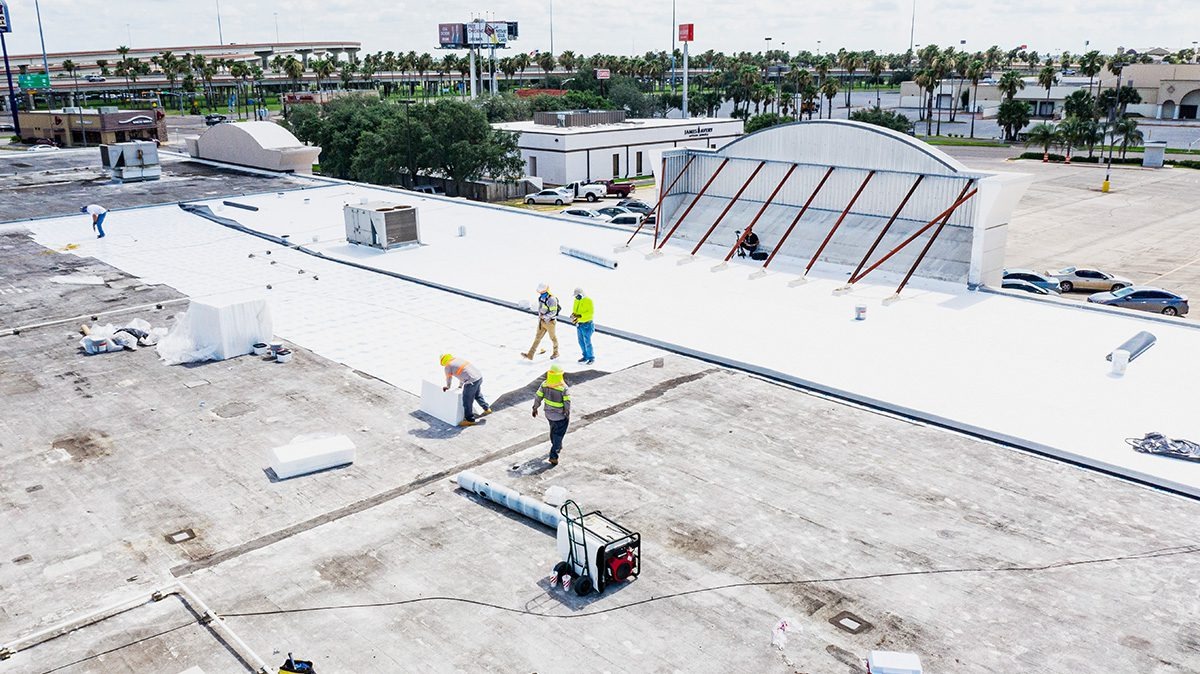
Financial Services Facility Roofing Minneapolis
Minneapolis is a major U.S. financial center, U.S. Bancorp's world headquarters on Nicollet Mall, Ameriprise Financial's campus in the IDS Center and Edina, and dozens of regional and community bank buildings across Hennepin County. Financial services facilities have specific documentation, insurance, and business-continuity requirements that roofing contractors rarely understand until they are standing in a facilities manager's office trying to get a project approved.
U.S. Bank's world headquarters at 800 Nicollet Mall is one of the most prominent commercial addresses in Minnesota. The U.S. Bancorp Tower (commonly known as U.S. Bank Plaza) is a high-rise building whose mechanical penthouse and roof represent a complex scope environment, elevator machinery, HVAC for a multi-tenant skyscraper, communications infrastructure, and the kind of exterior envelope coordination that low-rise roofing contractors do not encounter. Roof work on high-rise financial services buildings in Downtown Minneapolis requires specific experience with crane protocols at downtown street intersections, Skyway-crossing impact management, and night-shift sequencing to avoid disrupting the building's tenants.
Ameriprise Financial occupies significant office space in Minneapolis, including positions in the IDS Center on Nicollet Mall and its own campus in Edina along Bren Road. Ameriprise's facilities team operates a disciplined vendor management program, contractor qualification, insurance at financial-institution minimums, and closeout documentation compatible with enterprise asset management. The Edina campus buildings are lower-rise and more typical in scope than the downtown high-rise work, but Ameriprise's procurement requirements apply to both.
Community and regional bank branches across the Twin Cities metro represent a steady volume of smaller-scale commercial roofing work, branch conversions, single-story bank buildings from the 1970s through 2000s, and drive-through facility roofs that require specific detail work around the drive-through canopy transitions. We handle this work on the same documentation and permitting standards as our major-account projects.
High-Rise and Downtown Financial District Roofing
Downtown Minneapolis high-rise roof work requires crane permits from the City of Minneapolis Public Works department, Skyway-crossing coordination for any equipment that will swing over the Skyway glass panels, and often requires night-shift operations to avoid impacting the Nicollet Mall pedestrian corridor during business hours. The U.S. Bancorp Tower and the surrounding Nicollet Mall financial district buildings, Wells Fargo Center, Capella Tower, 225 South Sixth, are all in a dense urban context where material staging, crane positioning, and debris management require a plan that accounts for the surrounding public environment.
Mechanical penthouse roofs on high-rise financial services buildings in Downtown Minneapolis house the building's HVAC, elevator machinery, and communications equipment for the entire tower. Scope on these roofs is never purely a waterproofing project, it is a coordination event with the building's mechanical engineering team, the elevator service contractor, and the telecommunications equipment operators. We do not treat the penthouse roof as a standard commercial project.
Business Continuity and BCO Requirements
Financial services buildings have business continuity obligations that most commercial buildings do not. U.S. Bank's operations center, Ameriprise's client-facing offices, and community bank branches all have defined business continuity requirements that govern how long they can tolerate a noise, vibration, or access disruption. We build these requirements into the production schedule during pre-construction planning, not as constraints we discover after mobilization.
Banking regulators and financial services clients expect that building maintenance and capital projects at financial institutions follow documented change management and vendor approval processes. We provide the documentation that bank facilities teams need to demonstrate that roofing work was conducted by a qualified contractor following an approved scope. This includes insurance certificates, contractor licensing verification, permit documentation, and a closeout package that satisfies the audit trail requirements of a regulated financial institution.
After-hours and weekend production windows are standard on financial services buildings where trading operationsmany commercial customers service centers, or data-processing runs cannot tolerate daytime disruption. We have the crew capacity to run weekend and night-shift production on deadline-driven financial services projects, and we build this capacity into the project schedule when the pre-construction planning reveals it is required.
Branch Network and Community Bank Buildings
The Twin Cities metro has hundreds of bank branch buildings, U.S. Bank, Wells Fargo, Bremer Bank, Alerus Financial, and dozens of local credit unions, that represent a consistent commercial roofing market. Most branch buildings are single-story or two-story structures from the 1970s through 2000s, on flat or low-slope roof systems that are approaching or past their design service life.
Branch network roofing programs for portfolio managers and property managers who oversee multiple locations benefit from standardized condition assessment, prioritized replacement scheduling, and consistent documentation across all properties. We run multi-property inspection programs for bank branch portfolios and deliver condition reports in a format that allows portfolio managers to build a multi-year capital replacement schedule from a single data set.
Can you handle roofing on occupied high-rise buildings in Downtown Minneapolis?
Yes. Downtown Minneapolis high-rise roof work is part of our project portfolio, we understand crane permitting from Public Works, Skyway-crossing coordination, and night-shift sequencing requirements. Pre-construction planning for a downtown high-rise project includes a coordination meeting with the building's property management team, the affected tenants, and any city permits required for crane or street-lane use.
What documentation do you provide for financial institution audit requirements?
Our closeout package for financial services buildings includes: contractor licensing and insurance documentation, permit records (pulled and closed), a photo-keyed roof zone diagram, the manufacturer warranty document, a snow load analysis for the building's jurisdiction, and a maintenance plan. We format this documentation to satisfy the audit trail requirements that bank regulators and financial institution compliance programs expect.
Do you handle roofing for bank branch portfolios with multiple Twin Cities locations?
Yes. We run multi-property inspection programs and capital planning services for bank branch portfolios across the Twin Cities metro. A single inspection engagement produces condition reports and replacement priority rankings for all locations, in a format that a portfolio manager can use for multi-year capital budgeting. Call 612-712-4052 to discuss a branch portfolio assessment.