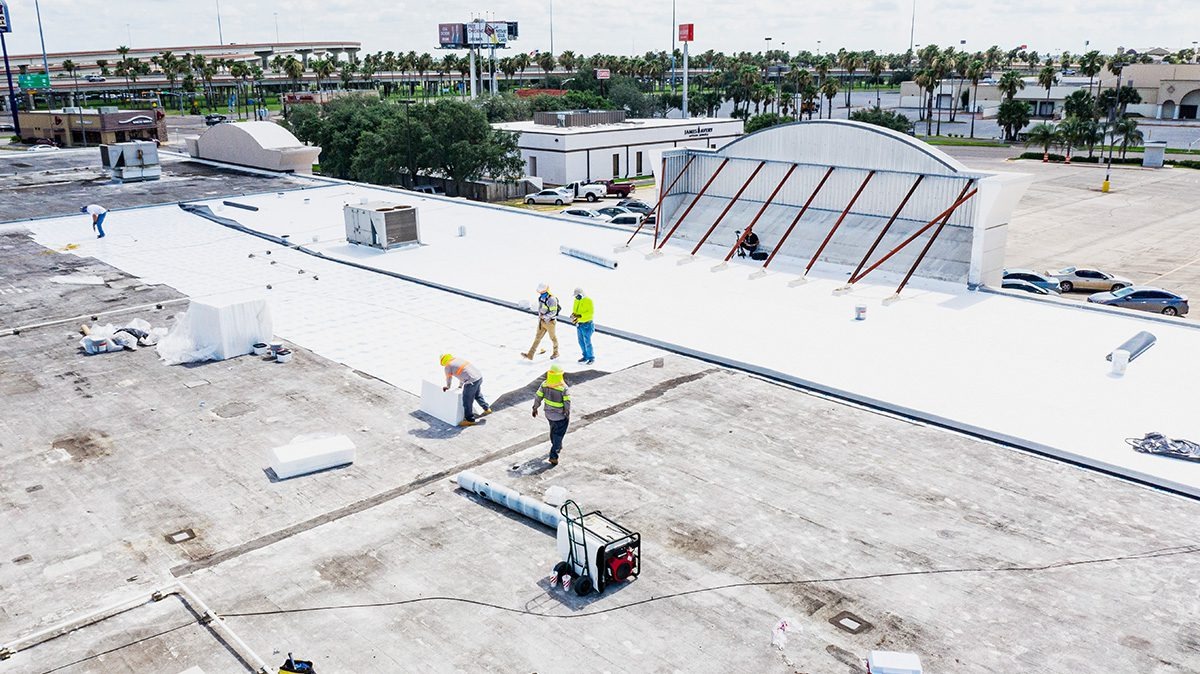
Manufacturing Facility Roofing Minneapolis
Manufacturing plants in the Twin Cities metro, 3M's Maplewood campus, Cargill's Wayzata facilities, Land O'Lakes in Arden Hills, run continuous production schedules that a roofing project cannot interrupt. Large-footprint industrial roofs with skylights, ventilation stacks, and process-equipment penetrations require a scope grounded in the plant's operational calendar, not the contractor's.
3M Company's campus in Maplewood is one of the largest industrial roof footprints in the Twin Cities metro. The campus spans dozens of buildings ranging from original mid-century manufacturing facilities to modern research and development structures. 3M's facilities management operation runs a sophisticated asset management program and expects roofing contractors to deliver condition assessments, project scopes, and closeout documentation in formats compatible with that program. Large-footprint roofing projects on 3M campus buildings require production sequencing that maintains continuous weathertight cover over active manufacturing and laboratory areas.
Cargill's facilities in Wayzata and the surrounding west-metro area represent a different industrial roofing challenge: food-production-adjacent facilities where contamination risk drives procurement and safety decisions. Cargill's vendor qualification process requires roofing contractors to demonstrate familiarity with food-safety requirements for facilities work, materials selection, debris containment, and cleanup protocols are all subject to review. We understand these requirements and build them into the project scope.
Land O'Lakes in Arden Hills anchors the Ramsey County industrial corridor north of I-694. The Arden Hills campus has a mix of building vintages and roof systems. Many of the older manufacturing buildings carry original or early-replacement modified bitumen systems that are well past their design service life. Snow load compliance is critical on large-footprint manufacturing buildings, the structural design loads for these buildings were set at original construction, and any recover or replacement scope that adds roof system weight must account for the structural margin available.
Large-Footprint Industrial Roof Sequencing
A 200,000 sq ft manufacturing facility roof is not roofed in one continuous pour, it is managed as a series of contained sections, each dried in before the next section opens. On manufacturing facilities where production runs continuously, section boundaries are set to align with the plant's structural bays, so each section can be dried in without the open-membrane area ever extending over active production lines below.
Material staging on large industrial sites requires coordination with the plant's receiving and logistics team. We do not use the truck dock or receiving area for roofing material delivery during production hours without advance authorization. Crane positioning on campus buildings where overhead cranes or rail lines create positioning constraints is planned during the pre-construction site visit, not improvised on the day of the lift.
Hot-work permits on manufacturing facilities are issued by the plant safety manager under site-specific procedures that may be more restrictive than the municipal fire code. 3M's Maplewood campus, for example, has product storage areas and chemical handling processes that create fire-safety zones with no-hot-work requirements that extend well beyond the standard code separations. We receive and review the plant's hot-work procedures before mobilization.
Industrial Roof System Considerations
Manufacturing buildings in the Twin Cities metro frequently have skylights and translucent panels that provide natural light to the production floor. Roofing scope around skylights requires careful detailing, the skylight curb is one of the most common failure points on industrial roofs, and a leak at a skylight curb on a production floor can contaminate product below. We include skylight curb condition in every inspection walk and detail curb flashings with a full-adhered system that can handle the ice jacking movement at the curb-to-deck interface.
Process equipment penetrations, ventilation stacks, exhaust fans, condensate drains from process cooling systems, and pressure-relief vents, are more numerous and more varied on manufacturing roofs than on office or retail buildings. Each penetration requires a custom flashing detail suited to the pipe diameter, temperature, and chemical exposure. On 3M campus buildings, some process exhaust streams have chemical exposure profiles that require specific membrane compatibility, we review the list of exhaust streams during pre-scope inspection and specify compatible materials accordingly.
Snow load compliance on large-span manufacturing buildings is a structural engineering question, not just a roofing decision. Adding a recover layer (typically 2 to 4 inches of polyiso and a new membrane) adds 2 to 4 psf of dead load to the roof. On buildings already carrying 35 to 40 psf design snow loads, this additional dead load may be within the structural margin or may require a structural review. We document existing roof system weight and new system weight in every recover scope on older manufacturing buildings so the owner's structural engineer can verify the load is within capacity.
Food-Adjacent and Chemical-Adjacent Facilities
Cargill's food-production facilities in Wayzata and the broader west-metro area require roofing contractors to implement debris-containment protocols that prevent roofing materials, fasteners, and abraded membrane particles from entering the food-production environment below. This means full containment at all parapet openings, magnetic sweeping of the roof surface after any fastener-intensive work, and documented cleanup inspection at the end of each work day. We provide the Cargill facilities team with a daily cleanup log.
Land O'Lakes' Arden Hills campus similarly requires food-safety-adjacent protocols for buildings that house dairy product manufacturing and processing. Membrane and adhesive selection for food-adjacent buildings prioritizes materials with low off-gassing profiles, and we review the SDS sheets for all adhesives and primers with the plant's environmental health and safety team before specification finalization.
How do you handle roofing on a manufacturing facility that runs 24/7?
We scope the project in sections mapped to the plant's structural bays and production layout, with section sizes that can be completed and dried in within a single work shift. We coordinate with the plant's production manager to identify which areas can accept the noise and vibration of tear-off operations and at what times. Critical production windows, shift changes, quality inspection periods, scheduled maintenance shutdowns, are documented in the pre-construction plan and avoided during the most disruptive operations.
Do you have experience with the 3M Maplewood campus vendor qualification process?
We understand the requirements that large corporate industrial campus facilities teams put on contractor qualification, insurance at appropriate limits, safety program documentation, familiarity with site-specific hot-work and access procedures, and closeout documentation compatible with asset management systems. We work through these qualification processes at the start of the project, not after contract signing.
How do you document snow load compliance for a recover project on an older industrial building?
We record the existing roof system assembly and estimated weight per square foot during the inspection walk. The proposed recover system weight is calculated from the specified materials. Both are provided in the project scope document so the owner's structural engineer can verify the total roof dead load against the building's structural design capacity before we proceed. We do not skip this step on large-span manufacturing buildings where the structural margin may be limited.