Retail Roofing Minneapolis, Mall of America, Southdale, Ridgedale & Strip Centers
Mall of America in Bloomington, Southdale Center in Edina, Ridgedale Center in Minnetonka, and the broad suburban strip-center and big-box inventory across Hennepin, Ramsey, and Dakota Counties represent a diverse retail roof portfolio, from multi-level enclosed mall structures to open-air lifestyle centers to single-story anchor boxes. We scope for the operational constraints each retail format imposes.
Retail building roofing in the Twin Cities runs the full size spectrum. At one end: Mall of America in Bloomington, one of the largest retail facilities in North America, with a roof system spanning multiple levels, a theme park in the center court, and a facilities management organization that operates structured contractor qualification programs. At the other end: the suburban neighborhood strip centers scattered across Hopkins, Richfield, Crystal, and New Hope, 8,000 to 30,000 square foot neighborhood retail buildings with single-story flat roofs that have often been owned by the same investor since original construction in the 1970s or 1980s and are well past the recover decision point.
Southdale Center in Edina holds particular significance in this market, it was the first fully enclosed shopping mall in the United States, opened in 1956, and the original structure has been expanded and renovated multiple times since. The roof systems on different sections of Southdale reflect different construction eras: sections of the original 1956 structure, the 1970s and 1980s expansions, and the more recent renovation sections all have different roof systems at different points in their service life. Managing a complex like Southdale requires understanding the construction history and matching the scope to each building section's specific conditions. Ridgedale Center in Minnetonka, opened in 1974 and renovated multiple times since, presents similar multi-era complexity.
The operational constraint on retail roofing is non-negotiable: stores must remain open and customer-accessible throughout the project. No retail property manager will accept a scope that closes parking areas, blocks entrances, or restricts customer access during business hours. We design the production sequence around this requirement from the first scope meeting.
Large-Format Retail: Malls and Anchor Centers
Mall of America in Bloomington: The MOA roof represents a specialized project type. The building's scale, approximately 5.5 million square feet of total floor space, and its operational status as a 365-day-per-year public facility with peak visitor counts on weekends and holidays require production scheduling that minimizes conflict with high-traffic periods. The MOA facilities team runs a formal contractor qualification and approval process; we work within that process. Rooftop access logistics at MOA are distinct from any suburban retail building, equipment lifts, crane positioning, and material staging are all managed through the facilities department's coordination protocol.
Southdale Center and Ridgedale Center: Edina's Southdale and Minnetonka's Ridgedale are owned by large retail real estate investment trusts that manage maintenance and capital improvement through institutional facilities management organizations. Roof work on these properties requires integration with the owner's capital planning cycle, typically a 5-year capital plan with specific roof sections scheduled in specific fiscal years. We provide the condition reports and cost projections that support this planning cycle, including a current-condition report on sections not yet scheduled for replacement so the owner has forward visibility into the full asset.
Anchor box retail, Target, Costco, Home Depot, Menards, present at dozens of locations across the Twin Cities metro. These buildings are typically on the retailer's own facilities maintenance program with national contract structures, but landlord-owned anchor pads in power center developments often fall outside the retailer's maintenance scope. We work with both landlord facilities teams and retailer facilities organizations on anchor box roof work.
Strip Centers and Neighborhood Retail
The suburban strip center inventory across Hennepin and Ramsey Counties ranges from well-maintained anchored centers under institutional ownership to struggling neighborhood retail in cities like Crystal, Robbinsdale, and Columbia Heights that has not had a capital improvement since the 1990s. Older strip centers in these markets present the recover-or-replace question starkly: 30 to 40 year old built-up roofing systems with multiple generations of modified bitumen patch repairs, inadequate drainage that produces ponding in every large drain area, and parapet walls that have moved enough to crack every prior flashing installation.
Our strip center work is heavily weighted toward planning and documentation. The owner of a struggling neighborhood retail center needs to know the actual condition of the roof, whether the building has 2 years left on a patch-and-maintain program or whether the decision has already been made for them by the deck condition underneath. We provide this honest assessment so owners can make real capital decisions rather than continuing to pay for patch repairs that do not address the underlying condition.
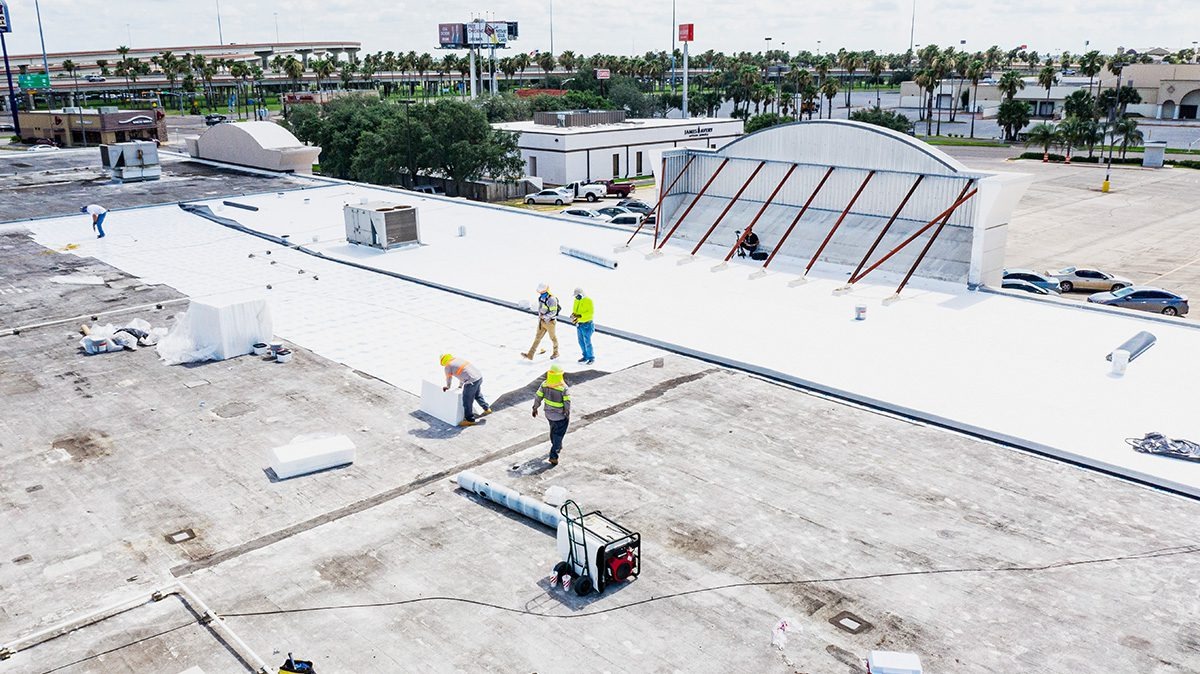
Production on occupied strip centers requires tenant communication, temporary walkway protection for customer access to storefronts, and debris management that keeps the parking field clean during and after each production day. Gravel from torn-off BUR systems is a tire hazard in retail parking areas, we use contained debris chutes and daily cleanup protocols that protect both vehicles and pedestrian access.
Minnesota Winter and Retail Roof Design
Large-footprint retail buildings in the Twin Cities accumulate snow at rates that smaller buildings do not. An unobstructed 200,000 square foot single-story box in Bloomington or Eden Prairie can carry 2 to 3 million pounds of snow at design load, the structural design assumes that load is managed through adequate drainage to prevent ponding and meltwater backup. When drain systems are inadequate or frozen, the weight stays on the roof.
Ridgedale Center and Southdale Center both have enclosed mall structures where interior heat escape through the roof can create differential melting patterns, areas of the roof directly above enclosed mall space may see melt-refreeze cycles that perimeter sections adjacent to exterior walls do not. We document these thermal variation zones during inspection and specify membrane and insulation details that account for the differential movement they create.
Snow load monitoring as a maintenance service is particularly valuable for large retail properties. We establish written snow depth thresholds, keyed to the structural design snow load for the specific building, and provide the facilities team with a monitoring protocol that allows them to track accumulation during multi-day storm events and call for snow removal before accumulation approaches structural design limits.
Can you work on Mall of America?
We have experience with large institutional retail facilities and understand the coordination a property like MOA requires. We work within the MOA facilities team's authorization and scheduling process. Contact us to discuss your specific scope and we can confirm our qualification status and availability for your project timeline.
How do you keep retail stores open during roof work?
Production sequencing is the primary tool. We work in sections that allow each store to remain accessible from the parking area and from adjacent retail access points. Temporary customer walkway protection, overhead protection at building entrances, parking stall closures limited to the active crane zone, and daily cleanup to remove roofing debris from the pedestrian path, is included in the scope as a standard item on retail projects, not an add-on.
What is the lead time for getting a strip center roof scope in the Twin Cities?
For a straightforward strip center inspection and scope, no unusual deck conditions, standard drain configuration, we can typically complete the roof walk and produce a written scope within 5 to 7 business days of the initial call. If the scope reveals deck conditions that require additional investigation (probe cores, structural drawing review), add 3 to 5 business days for the additional documentation. Call us at 612-712-4052 to schedule.