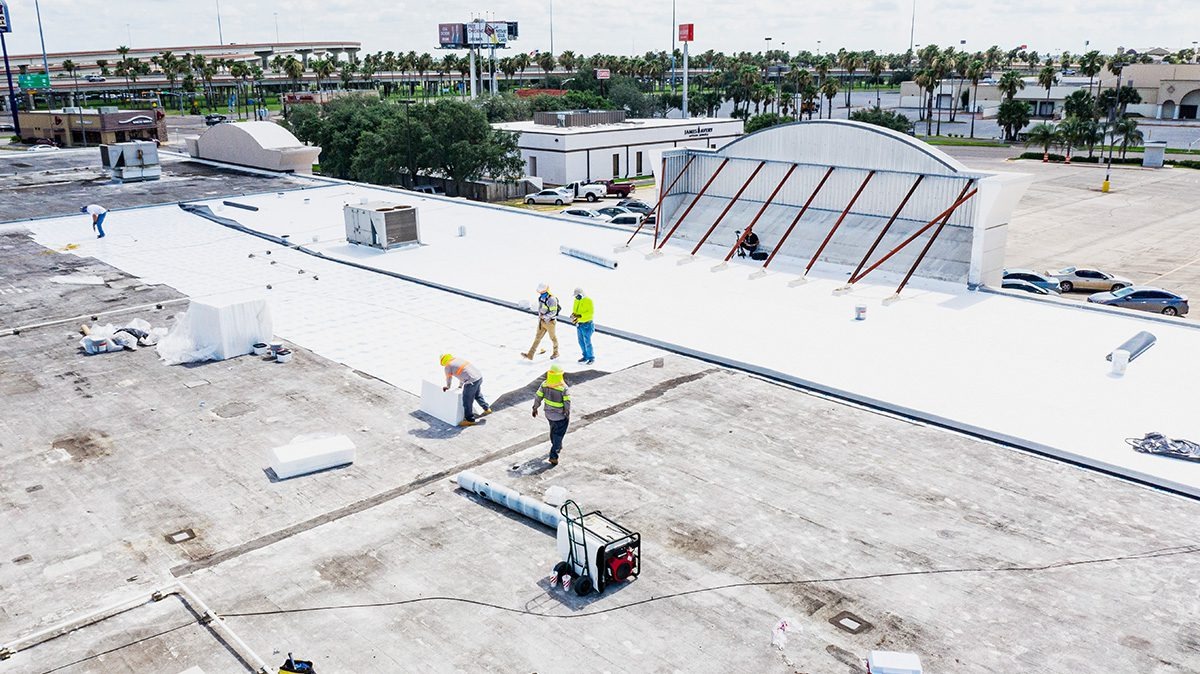
Data Center Roofing in Minneapolis, MN
Data Center Roofing for commercial buildings across Minneapolis.
Minneapolis warehouse and industrial roofing divides into two very different populations. The older stock, the brick-and-timber buildings along the North Loop, the Northeast Minneapolis industrial corridor east of Central Avenue, and the Prospect Park warehouses near the University of Minnesota, dates from the 1900s through the 1940s. These buildings carry original wood plank decks, often on timber structural frames, and have been reroofed multiple times with layers that include built-up roofing, modified bitumen patches, and in some cases early-generation EPDM from the 1980s. The accumulation of multiple roofing layers and decades of deferred maintenance means almost every older warehouse we inspect has saturated insulation somewhere.
The modern industrial population, distribution and fulfillment centers along Highway 169 in Plymouth, the I-494 corridor near MSP airport in Bloomington, and the industrial parks in Brooklyn Park and New Brighton, runs large-span steel decks with TPO or single-ply membrane systems from the 1990s and 2000s. These buildings are now at first major maintenance milestones or approaching the decision between recover and replacement. Snow loads are the critical design factor on both populations: the warehouse footprint, combined with low parapets and minimal mechanical equipment to create favorable drift geometry, means that unobstructed roof spans accumulate snow quickly during multi-day storm events.
We bring probe cores, moisture meters, and a structural drawings review to every warehouse inspection. The goal is to know what is actually under the membrane before we write the scope, not after the crew opens up a section in February and finds a wood deck with three inches of saturated insulation.
What We Look for in Older Minneapolis Warehouse Buildings
Deck condition under multi-layer accumulations: North Loop and Northeast Minneapolis warehouses from the early industrial era frequently have original 2x6 or 2x8 wood plank decks. We probe these decks under moisture core locations and at deflection points. Ice dam infiltration over decades can cause wood rot that is invisible from below until a crew removes the roofing system. We identify deck repair zones before the project starts so the owner has an accurate scope and budget.
Drain configuration on flat-span roofs: Older warehouses were often designed with minimal drain points, one interior drain per 10,000 square feet was common in the 1920s and 1930s. Current Minnesota drainage design standards require more frequent drain points to handle the 100-year storm event, which in Hennepin County runs approximately 3.5 inches per hour peak. We identify inadequate drain spacing and recommend drain addition as part of the replacement scope where the deck allows penetration.
Parapet height and ice dam exposure: Low parapets on old Minneapolis warehouse buildings, sometimes as shallow as 8 inches, concentrate ice dam pressure at the membrane termination point. We extend new membrane up the parapet face at least 12 inches above the design snow depth for the building's location and install a fully-adhered flexible termination bar detail that tolerates ice jacking movement.
MSP Airport and Highway Corridor Industrial Buildings
Distribution and fulfillment centers in Bloomington near MSP airport and along the I-494 strip present a different set of conditions. These are large single-story steel-frame buildings with metal deck, typically 100,000 to 500,000 square feet of continuous roof surface, and operational constraints that make staged production mandatory, tenant operations cannot be disrupted for more than a few hours per section. We scope these projects with 10,000 to 20,000 square foot daily production units, same-day dry-in on each section, and pre-production coordination with the facility manager for staging zone layout and dock access restrictions.
Rooftop mechanical equipment on distribution center buildings, HVAC units, exhaust fans, makeup air units, creates drift accumulation zones that we document during inspection. A 12-foot-tall mechanical screen on a large-span roof in a northwest wind exposure can generate drift loads exceeding 80 psf at the downwind base. We flag these locations for the building owner's facilities team and include them in the snow accumulation monitoring plan on maintenance contracts.
The Plymouth and Brooklyn Park industrial corridors, particularly the Highway 6 industrial parks, have active development pressure that produces new-construction scope review requests alongside established building maintenance work. Our familiarity with the older building stock in these corridors, the 1980s and 1990s tilt-up construction that forms the majority of the Plymouth industrial park inventory, lets us provide meaningful condition assessments and recover-vs-replace recommendations grounded in that specific building type.
Roof System Selection for Minneapolis Warehouses
TPO is the dominant replacement choice for Minneapolis warehouse roofing today. The 60-mil and 80-mil mechanically-attached and fully-adhered options provide reliable performance in Minnesota's freeze-thaw cycling, and the reflective white surface reduces summer cooling load in unconditioned warehouses, particularly relevant for distribution centers where dock doors cycle constantly and interior temperature management is an operating cost. TPO seams welded with calibrated hot-air equipment at the right dwell time and membrane temperature hold reliably through Minneapolis winters.
EPDM fully-adhered remains a viable option on older buildings where the deck condition favors a fully-adhered system and where the owner prefers a proven long-service-life membrane. The single-ply black membrane provides good flexibility in cold temperatures and tolerates the structural movement that older North Loop warehouse buildings exhibit as they age. We match the membrane choice to the specific deck type, building use, budget horizon, and warranty path, not to a preferred product.
Modified bitumen (SBS) is the right material for complex repair scopes on older buildings with multiple roof levels, irregular geometry, and penetrations that demand hand-formed flashing work. The SBS modifier keeps the bitumen flexible at Minneapolis winter temperatures. On older Northeast Minneapolis warehouses with multiple roof levels and dozens of penetrations, torch-applied SBS modified bitumen lets us build robust custom flashings at conditions that a single-ply membrane cannot address cleanly.
How do you handle snow removal during a warehouse roof replacement in the winter?
We include a snow management plan in the pre-construction package for any project running November through March. For large-footprint warehouse buildings, we identify roof zones where snow accumulation can approach the design load during active production, and we specify snow removal as a line item before any section is opened for tear-off. We do not open roof sections adjacent to active snow accumulation without a removal plan in place.
Can you work around warehouse operations, dock activity, forklift traffic near the building, tenant hours?
Yes. We coordinate material lay-down zones, crane positioning, debris removal, and access routes with the facility manager before production starts. For occupied distribution centers, we use dawn-start shifts on sections adjacent to active dock operations and schedule the loudest work (tear-off) during the facility's lowest-activity windows. All of this is documented in the pre-construction coordination memo.
What is the typical lifespan of a TPO roof on a Minneapolis industrial building?
A 60-mil mechanically-attached TPO roof installed with manufacturer-approved details in Twin Cities conditions typically carries a 15- to 20-year manufacturer warranty. 80-mil systems carry 20-year warranties. Actual service life with annual inspection and prompt minor repair routinely exceeds the warranty period. We document the installation conditions, insulation R-value, and drain configuration at closeout so the next reroof cycle has accurate baseline data.