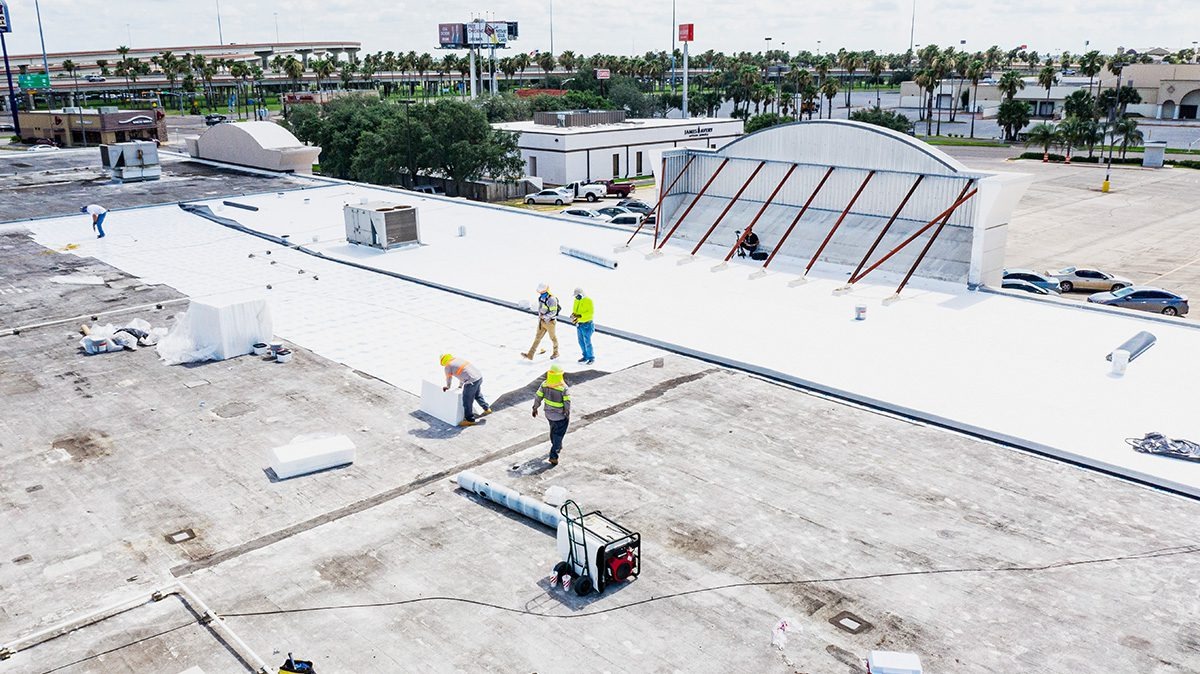
Movie Theater & Cinema Roofing in Minneapolis, MN
Roofing Over the Auditorium: Big Spans, Heavy Equipment, Quiet Houses
A cinema roof is defined by what it has to span and what it has to keep quiet. Each auditorium is a wide, column-free room, sloped-floor stadium seating below, eighty to a hundred and fifty feet of clear span across the deck above. That span deflects under load in ways a strip-retail fastening pattern was never designed for. And because audiences pay to sit in the dark and listen, the roof also has to keep rain noise, hail drumming, and rooftop-unit vibration out of the room. Those two demands, structure and acoustics, drive how we build over a theater.
Minneapolis still supports a real moviegoing market. The metro is home to large multiplexes in destination retail centers, and downtown anchors like the AMC at the Mall of America in neighboring Bloomington draw from across the region. Long winters do for cinemas what they do for gyms: they fill the seats, and they hammer the roofs with snow load and freeze-thaw cycling that a southern theater never sees.
Why a Cinema Isn't a Big-Box Store
It's tempting to roof a multiplex like any large low-slope retail building, and that assumption is exactly where cinema roofs go wrong. The clear spans are longer, the equipment is heavier and more concentrated, the interior carries a noise standard no store has to meet, and the floor plan funnels everything, patrons, deliveries, service access, through a few controlled points. A roofing approach copied from a strip center ignores all four of those differences. We treat a cinema as its own building type, starting from the auditorium structure and working out, so the membrane, the insulation, the fastening, and the detailing all answer the demands the building actually places on them.
Most auditoriums sit on steel deck over structural steel, though some older houses use concrete. The substrate decides the attachment method. Steel deck takes mechanical fastening, but only at a density appropriate to the rib depth and gauge, and we pull-test before relying on a published value, because aging short-rib deck underperforms. On the longest spans, where deflection is a concern, we'll specify an adhered or hybrid system so fasteners aren't concentrating stress along the seams as the deck flexes. We core the roof first to confirm existing layers, moisture content, and total weight in place before recommending recover or full tear-off.
Acoustic isolation is a design input, not an afterthought, on a cinema reroof. Mechanically fastened single-ply over a hard deck can telegraph rain and hail straight into a quiet auditorium. We address that with insulation layering and assembly choices that add mass and dampening over the seating areas, and we pay particular attention to how rooftop units are curbed and isolated so unit vibration doesn't carry down into the room during a screening. The audience should never hear the building working.
A Roof Full of Mechanical Penetrations
Cinemas carry a mechanical load closer to a hospital than a store. Each auditorium typically gets its own rooftop unit; on top of that sit concession exhaust, kitchen and grease-duct penetrations for expanded food-and-beverage service, lobby heating vents, and condensers for walk-in coolers. The cluster of curbs and penetrations above a multiplex is dense and unforgiving, each one is individually flashed and documented before new membrane goes over it. Tapered polyiso is almost always part of the specification, because decades of flat theater roofs leave drainage deficiencies and ponding that only a tapered design corrects. White TPO meets the cool-roof requirements most jurisdictions now apply.
Marquees, Canopies, and the Evening Schedule
Entry canopies and marquee signage penetrate the membrane at the front of the building, and those transitions are a classic chronic-leak source on older theaters. We treat each as its own flashing item and re-detail it rather than rolling it into the field membrane. Scheduling, meanwhile, works around the show calendar: cinemas open in the afternoon and run late, seven days a week, so we sequence tear-off and dry-in to leave every section watertight before the evening's first screenings and coordinate any rooftop-unit shutdowns with facilities so a packed Friday house isn't sitting under an open roof.
Snow Load and Drainage on a Cinema Deck
A multiplex presents a large, broken roof plane, tall fly-tower-style volumes over the screens, lower roofs over lobbies and corridors, and the parapets and equipment screens between them. In a Minneapolis winter that geometry traps drifting snow at every height change, and the meltwater has to find a drain rather than backing up against a curb and refreezing. We design tapered insulation and crickets to route water decisively off each level, add overflow protection where parapets would otherwise pond water, and pay attention to the transitions between high and low roofs where ice tends to build. On the long auditorium spans, accumulated snow load is also a structural input into the fastening and assembly decisions, not just a drainage concern.
Phasing a Reroof Without Going Dark
A theater that closes loses its revenue for every dark day, so we phase cinema work to keep as many houses open as possible. The roof is divided into zones tied to specific auditoriums, and we sequence tear-off and installation so a screen can keep showing while the roof two doors down is being replaced, or so a given house closes only for the short window its own roof section is open. Material staging avoids the lobby and concession entrances, and hot work and the loudest demolition are timed against the show schedule. The result is a reroof the box office can plan around instead of one that shuts the building.
We price cinema reroofs per roof square after a walk and core review, with tapered insulation and acoustic detailing carried as line items so the owner can see exactly what the long-span, quiet-house requirements add. Closeout includes the permit and final inspection, warranty registration, and a roof-zone diagram mapping every curb and penetration over the auditoriums so the facilities team knows precisely what sits over which house.
- Airport Terminal Roofing
- Fire Station Roofing
- Retail Roofing
- Grocery Store Roofing
- Mixed Use Development Roofing
- Built Up Roofing
- Healthcare Facility Roofing
- Commercial Roof Repair