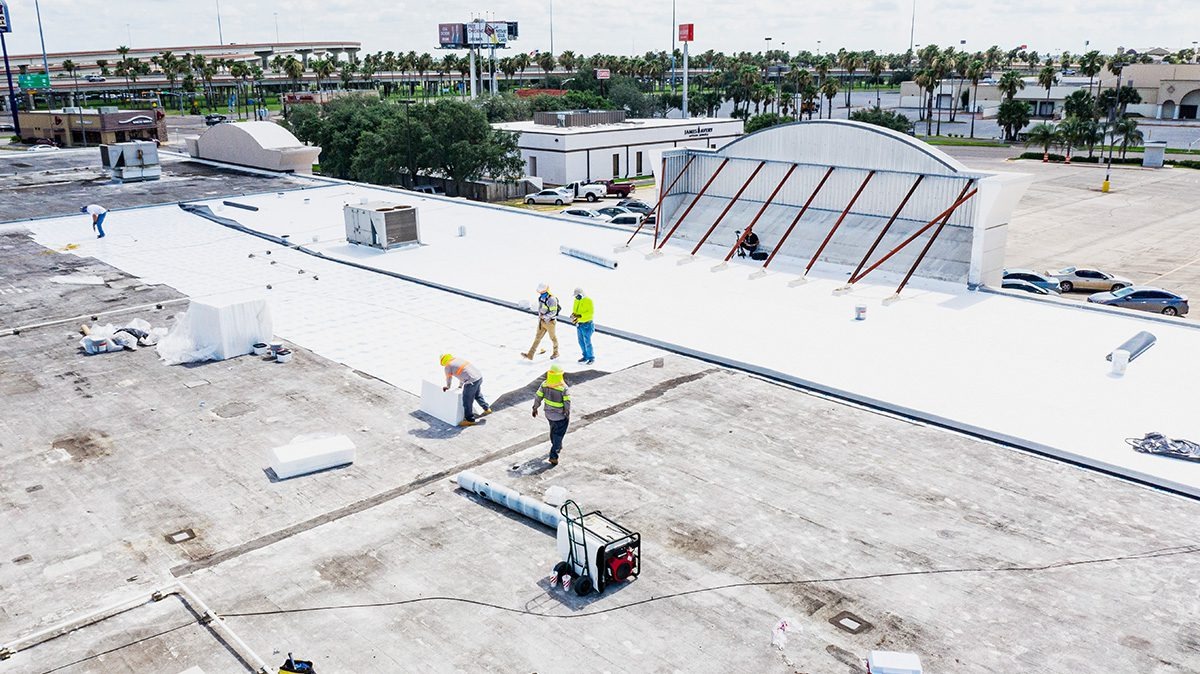
Silicone Roof Coating Systems Minneapolis, Fluid-Applied Recover & Warranty
Silicone coating recover is a legitimate 10 to 15 year life extension for qualifying Twin Cities commercial roofs. The critical variable is substrate qualification, a silicone coating applied over wet insulation or failing seams will fail in the same locations within two Minnesota winters. We do the moisture core work and seam assessment that makes the warranty hold.
Silicone fluid-applied coating systems are one of the most oversold products in commercial roofing across every market we track, and Minneapolis is no exception. The proposition is genuine: a properly applied 20 to 25 mil silicone coating over a clean, dry, well-prepared substrate can extend a roof system's service life 10 to 15 years and carry a manufacturer warranty. The abuse is equally genuine: coatings applied over saturated insulation, failing seams, or inadequately prepared surfaces that fail in the first significant weather event and produce warranty denial letters.
In Minneapolis, the substrate qualification stakes are higher than in warmer markets. Saturated polyiso insulation under a coated membrane does not just void the warranty, it collapses structurally under freeze-thaw cycling and presents a structural risk under the Twin Cities' 35-psf design snow loads. A coating that masks wet insulation in a Minneapolis building creates a compounding liability: the owner thinks the roof is protected, the insulation continues to absorb moisture and lose R-value through the winter, and by the time the coating begins to fail the insulation condition is significantly worse than it was when the coating was applied.
We install silicone coating systems on Minneapolis commercial roofs where the substrate qualifies, and we turn away coating work when it does not. Buildings that pass our moisture core and seam evaluation get a written coating recommendation with the specific system, application rate, DFT requirement, estimated service life extension, and the manufacturer warranty path. We specify coating systems that are formulated for Minnesota's temperature extremes: silicone formulations that remain flexible at -25°F and do not crack during the rapid freeze-thaw cycling that characterizes Twin Cities shoulder-season weather.
Dry Film Thickness, 20 to 30 Mil and Why It Matters in Minnesota
Silicone coating warranty terms are tied directly to dry film thickness (DFT). A 10-year manufacturer warranty typically requires 20 mil DFT. A 15-year warranty requires 25 mil DFT. A 20-year warranty requires 30 mil DFT on most manufacturer systems. These are dry film measurements after the solvent or carrier fluid flashes off, wet application rates are higher to account for that volume loss. In Minnesota's application environment, where humidity and temperature affect drying rates differently than southern markets, we track wet film thickness during application and verify dry film thickness after adequate cure time.
Contractors who want to hit warranty DFT requirements without applying sufficient material will apply thin coats and call it done. We verify DFT during application with a wet-film gauge on every lift and confirm final DFT with a dry-film gauge after cure. Manufacturer warranty inspectors perform the same check at closeout, and projects that do not pass it risk a denied warranty claim. We do not leave that verification to chance on any Twin Cities project.
Substrate Qualification Protocol for Minneapolis Roofs
Substrate preparation is where silicone coatings succeed or fail on Minneapolis commercial roofs. Our protocol: pressure-wash the entire surface at minimum 3,000 PSI to remove chalking, loose granules, biological growth including algae and moss that are particularly prevalent in Minnesota's humid summer conditions, and contamination; allow minimum 48 hours dry time before any coating application; probe every seam and flashing for adhesion failure; repair all open seams with compatible seam tape or reinforcement fabric; replace any parapet flashing that shows ice jacking separation; and apply manufacturer-specified primer for substrates requiring improved silicone adhesion.
The drying requirement is where coatings fail on Twin Cities projects more than anywhere else. Minneapolis humidity from June through September, combined with the morning dew and fog conditions common in the metro's lake-and-river geography, means that a roof that appears visually dry can retain moisture content that prevents adequate silicone adhesion. We use impedance moisture meters at representative locations before any coating is applied, and we will reschedule coating days when substrate moisture content exceeds the manufacturer's application requirement rather than proceed and compromise the bond.
Coating Warranties and Minnesota Climate Code Compatibility
The silicone coating manufacturers whose systems we install on Minneapolis buildings include GE Enduris, Tremco, Henry, and Polyglass. Each has a warranty matrix tied to system selection, DFT, substrate compatibility, and applicator credentialing. We carry credentials with multiple manufacturers to ensure we can match the right system to the substrate type and the owner's warranty objective, a TPO substrate requires a different silicone formulation and primer system than a modified bitumen substrate.
Minnesota energy code (MN Rule 1323, the state's commercial energy code based on ASHRAE 90.1 and Climate Zone 6A requirements) specifies minimum solar reflectance values for low-slope commercial roofs on new construction and major reroofs. White silicone coatings applied over aged or dark substrates can bring the assembly into compliance with minimum SRI requirements, and CRRC-listed silicone products have published aged reflectance values that satisfy the energy code documentation requirement. We include energy code compliance documentation in the coating closeout package for projects that require it.
How do I know if my Minneapolis roof qualifies for silicone coating?
The qualification criteria are moisture cores and seam condition. We pull five to ten cores per 50,000 square feet of roof area. If the polyiso insulation reads dry on cores at representative locations, the seams are sound or repairable, and the parapet flashings are intact and show no ice jacking separation, your roof is likely a coating candidate. If cores show wet insulation, particularly common on roofs that have experienced ice dam infiltration at parapet walls, coating is not the right scope. Wet insulation under a coating is a structural liability under Minnesota snow loads, and we will tell you so.
What does silicone coating cost compared to TPO replacement on a Minneapolis building?
A 20-mil silicone coating system on a qualifying 50,000 sq ft Minneapolis building typically costs 30 to 45 percent of a full TPO replacement on the same building. For a qualifying substrate, that is a significant capital saving. The trade-off is a 10-year warranty versus 20 years for TPO replacement, and the need to make the same scope decision again at the end of the coating warranty term. We model both lifecycle costs so the comparison is explicit.
Can silicone coating be applied in Minneapolis fall or spring weather?
Silicone coating requires substrate temperatures above 40°F and no precipitation within 4 hours of application. In Minneapolis, that means spring application from mid-April through May and fall application through early October in most years, with daily weather monitoring against the National Weather Service forecast. We do not apply coating when frost is possible in the 24-hour window following application. Scheduling coating projects for the right application windows in Minneapolis requires planning; we build the weather contingency into the project schedule before contract signing.