Spray Polyurethane Foam (SPF) Roof Systems Minneapolis, Industrial Recover
SPF roofing creates a seamless, self-insulating surface that eliminates the seam failures common on conventional recover systems. The substrate qualification requirements and weather application windows narrow the viable project list significantly in Minneapolis, we apply SPF only where the conditions and substrate genuinely support it.
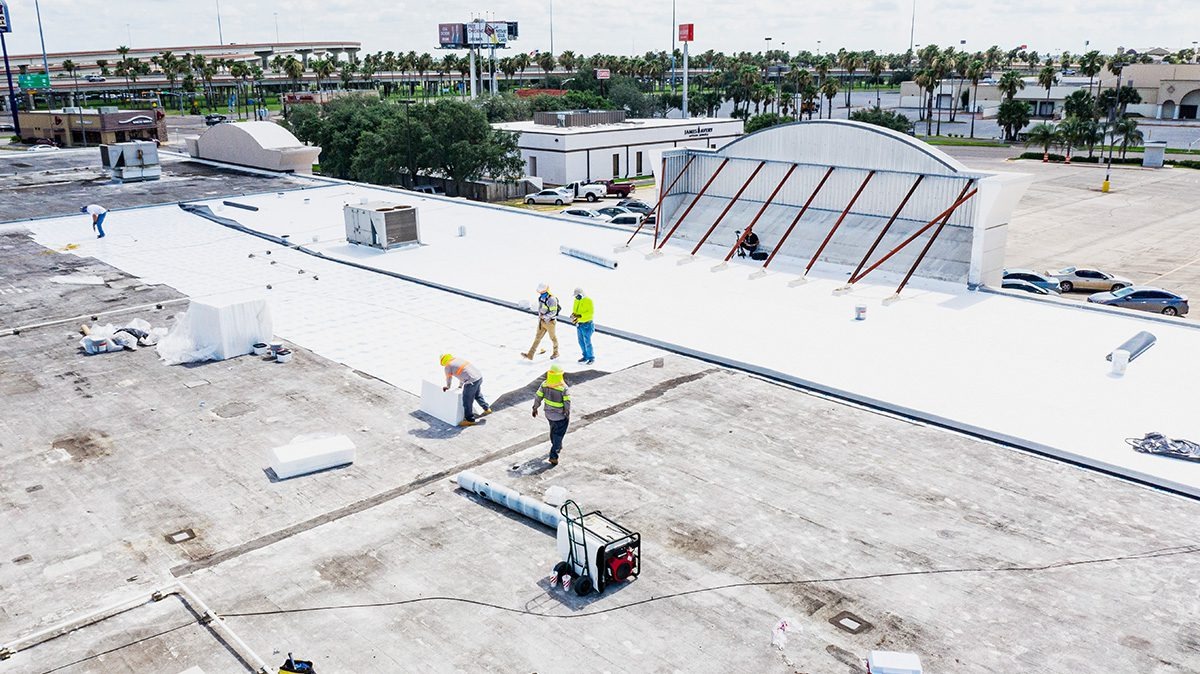
Spray polyurethane foam (SPF) roofing is applied as a two-component liquid that expands, adheres to the existing surface, and cures into a rigid closed-cell insulating layer. A protective elastomeric coating, typically silicone, is then applied over the foam to shield it from UV degradation and provide the waterproofing layer. The result is a monolithic, seamless roof surface with no laps, seams, or traditional penetration flashings, the foam conforms to the surface geometry and self-flashes around penetrations when applied at adequate thickness.
SPF is a recover system, it goes over existing roofing materials rather than replacing them. On large-footprint industrial buildings in the suburban Minneapolis industrial corridors, full tear-off of a 100,000 to 200,000 square foot roof means weeks of production disruption, significant debris disposal, and a large-scale open-roof weather management problem. When the existing insulation is dry and the substrate is stable and compatible with polyurethane adhesion, SPF recover can be faster, less disruptive, and less expensive than conventional single-ply recover on these large buildings.
The Minneapolis application environment narrows the SPF project window considerably. Wind speed above 12 mph during spray causes foam overspray drift that contaminates adjacent surfaces and produces an uneven application profile. Substrate moisture content must be near zero, stricter than the requirement for coatings or membrane adhesives, because foam bonds to moisture and produces a delaminated foam layer if the substrate is not thoroughly dry. In the Twin Cities, this means SPF projects work best in October, November before ground freeze, and March through April, outside the humid summer application risk period and outside the deep winter when substrate temperatures fall below the foam expansion range.
Closed-Cell Foam Density and R-Value for Minnesota Climate Zone 6A
SPF roofing uses closed-cell polyurethane foam at a density of 2.5 to 3 lbs per cubic foot. Closed-cell structure is what makes the foam waterproof, open-cell foam absorbs moisture and fails as a roofing material. We specify minimum 2.5 pcf closed-cell density on every Twin Cities SPF project and core-sample the installed foam to verify density before the protective coating is applied.
R-value per inch for 2.5 pcf closed-cell SPF is approximately R-6.5. Minnesota energy code (MN Rule 1323, based on Climate Zone 6A ASHRAE 90.1 requirements) specifies R-30 minimum for low-slope commercial roofs. A 4.5-inch SPF application reaches R-30 without any additional insulation below, on recover projects where the existing insulation below provides additional R-value, a thinner SPF layer can bring the assembly to code compliance. We calculate the existing insulation R-value from available documentation or from the estimated insulation type identified during inspection, then determine required SPF thickness to reach the code minimum for the specific project.
R-value stability under freeze-thaw cycling is an important SPF performance attribute in the Minneapolis market. Unlike polyiso insulation board, which loses meaningful R-value at sub-zero temperatures and under sustained moisture exposure, closed-cell SPF maintains its R-value across the Minnesota temperature range. For buildings where thermal performance consistency through the winter cycle matters, cold-storage facilities, buildings with condensation control requirements, SPF's stable R-value is a meaningful advantage over polyiso-based insulation systems.
The UV-Protective Coating Layer in Cold Climates
SPF foam is UV-sensitive and must be protected by an elastomeric coating applied immediately after the foam reaches its cure state. We apply silicone coating at 20 to 25 mil DFT over SPF on Minneapolis projects, silicone's flexibility at -25°F is critical in the Twin Cities market, because acrylic coatings that perform adequately in moderate climates can crack during rapid freeze-thaw cycling that is routine in Minnesota's fall and spring shoulder seasons. A cracked protective coating on a foam roof exposes the foam to UV degradation and moisture infiltration that progresses faster in the freeze-thaw environment than in warmer markets.
Coating layer application immediately after foam cure is the scheduling discipline that Minnesota projects require. Foam left unprotected for more than 24 to 48 hours in late fall or early spring risks moisture condensation that inhibits coating adhesion. We do not leave foam exposed overnight on Twin Cities SPF projects, the coating crew follows the foam crew on the same day, or we schedule the coating application for the following morning before substrate condensation develops.
Minneapolis Industrial Buildings Where SPF Makes Sense
The best SPF candidates in the Twin Cities market are large-footprint industrial buildings with complex roof geometry that would produce numerous field seams on a conventional single-ply recover. Multiple elevation transitions, extensive rooftop equipment, complex drain patterns, and irregular penetration layouts all benefit from SPF's seamless self-flashing application. Industrial buildings in the Brooklyn Park and Plymouth industrial corridors northwest of Minneapolis, manufacturing and distribution facilities along the I-94 and I-494 corridors in Minnetonka and Eden Prairie, and older light industrial buildings in the Northeast Minneapolis zone near Central Avenue are the building types that most often qualify.
One Minneapolis-specific SPF application opportunity is buildings with known ponding water issues. SPF can be applied in variable thickness to build positive slope to drains on a roof that does not have adequate structural slope, the foam fills low areas and creates a sloped surface that directs meltwater and rainwater toward the drain rather than allowing it to accumulate. On older flat-roof buildings in the North Loop and Northeast Minneapolis where structural slope was never designed into the original deck, an SPF application that builds positive drainage also addresses the ice dam risk from standing meltwater that refreezes at night.
Why doesn't every Minneapolis commercial building use SPF roofing?
Application window constraints. SPF requires wind below 12 mph during spray, substrate moisture content near zero, ambient temperatures in the foam expansion range, and no precipitation within 24 hours before or after application. In Minneapolis, those conditions align reliably in late fall before ground freeze and in early spring before the humid season, roughly a 60 to 90 day reliable application window per year. Single-ply membrane installs across a much wider range of conditions, which explains its dominance in the Twin Cities market.
Does SPF hold up to Minneapolis freeze-thaw cycling?
Closed-cell SPF foam itself is dimensionally stable and highly resistant to moisture infiltration, the closed-cell structure prevents water migration through the foam body. The vulnerability in freeze-thaw conditions is the protective coating layer: cracking of an inadequately flexible coating during rapid temperature cycling allows moisture to reach the foam surface. We specify silicone coating on all Twin Cities SPF projects specifically for its cold-flexibility advantage over acrylic alternatives, and we include annual inspection and coating patch as a standard SPF maintenance contract item.
What happens when an SPF system needs repair in Minneapolis?
Minor coating damage from foot traffic or hail is repaired with silicone patch material compatible with the installed coating system, and is straightforward to address. Exposed foam left unrepaired degrades under UV and moisture in a freeze-thaw environment faster than in warmer climates. We specify walkway pads on all foot-traffic paths on SPF projects and include annual coating inspection in our SPF maintenance contracts. Early coating patch is an inexpensive maintenance item; large-area coating failure requiring foam removal is a significant project. The difference is annual inspection frequency.