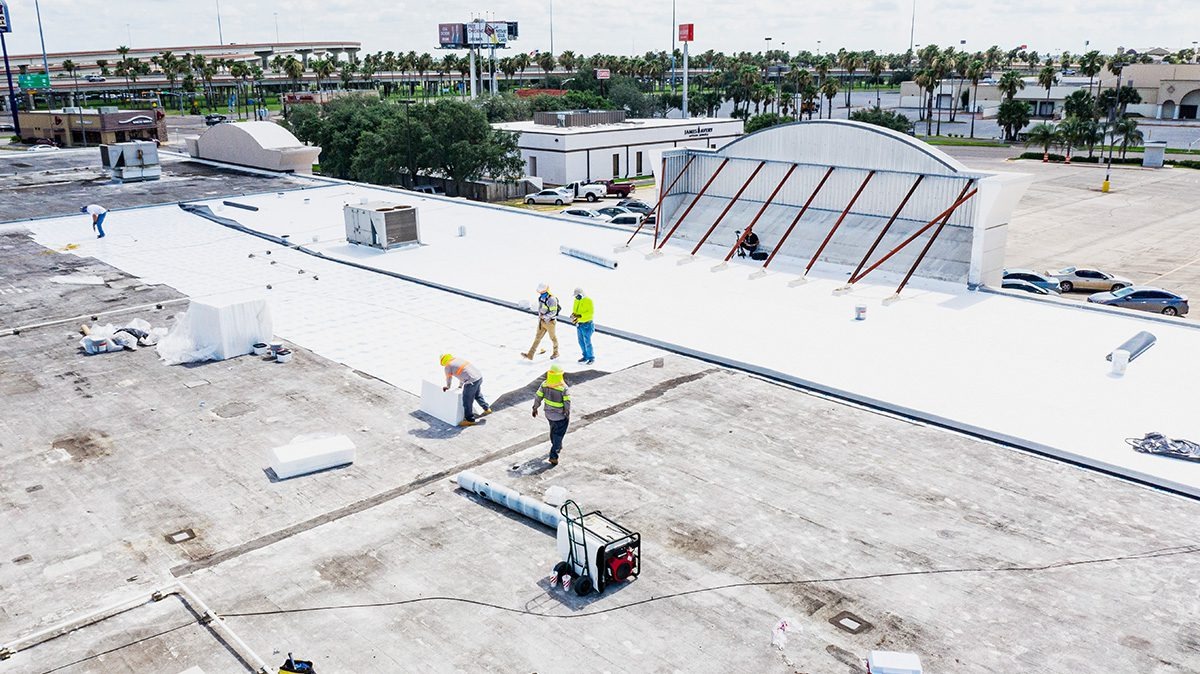
Built-Up Roofing (BUR) in Minneapolis, MN
Minneapolis has one of the largest concentrations of 1970s to 1990s commercial BUR inventory in the upper Midwest, downtown towers, North Loop warehouse conversions, and the original Uptown mixed-use stock. We maintain, repair, and recover these systems using materials that work in a freeze-thaw climate.
Built-up roofing is the original commercial flat roof system, layers of ply sheet felts alternated with hot bitumen, surfaced with aggregate or smooth cap sheet. The Twin Cities commercial building stock has an enormous BUR inventory: the 1970s and 1980s office tower buildout along Nicollet Mall and South Sixth Street, the North Loop warehouse-to-office conversions from the 1990s, and the first wave of Uptown and Northeast Minneapolis commercial construction all went up with BUR as the standard system. Much of that inventory is now at or past its original design life.
BUR systems in Minneapolis fail in a specific pattern. The hot bitumen becomes brittle after thirty years of freeze-thaw cycling, it loses the plasticizers that kept it flexible at Minnesota winter temperatures and develops surface cracking (alligatoring) that allows water infiltration. The gravel surfacing, if it was installed over a flood coat, provides meaningful protection through the cracking phase and buys years of continued service. Once the flood coat cracks through to the ply sheets, the clock runs fast, water infiltration saturates the insulation below and, in a freeze cycle, the expansion of that water destroys the ply sheet bond.
We approach BUR differently depending on where in that failure sequence the system sits. Early-phase alligatoring with intact ply sheets: a silicone or modified bitumen repair program extends service life at a fraction of replacement cost. Mid-phase with localized moisture infiltration and isolated wet areas under 25%: a hybrid recover with a new modified bitumen or TPO cap layer over the existing BUR buys another 15 to 20 years if the deck is sound. Late-phase with widespread saturation: full replacement is the honest answer.
Diagnosing Minneapolis BUR Condition
Moisture core sampling is the first diagnostic tool on any BUR system we assess in Minneapolis. We pull cores in a five-to-ten point grid, more on larger roofs, selecting locations based on surface condition: areas of active alligatoring, areas with surface depressions that suggest insulation collapse, areas near drains where saturation typically begins, and areas near parapet flashings where ice dam infiltration concentrates. Each core is inspected for moisture presence in the insulation layer and for delamination of the ply sheets from each other.
Infrared thermography is the second diagnostic tool for BUR systems on Minneapolis buildings. An infrared scan after sunset on a clear night, when the roof surface loses heat faster than wet insulation below, identifies wet areas that hold heat anomalously, these areas show as warm spots on the IR image. Minneapolis's 175-plus clear nights per year make IR scanning practical from April through November. We use IR to prioritize the core sample grid and to map the extent of wet areas on large roofs before committing to a recover or replacement scope.
Flashing condition at parapets and penetrations is the third assessment point. On BUR systems in Minneapolis, the bitumen counterflashing at parapet walls is typically the first failure point, ice jacking at the wall-to-membrane transition breaks the bond of the counterflashing to the wall face, and water runs behind the flashing and into the insulation. We probe every parapet counterflashing on every BUR system we inspect, and we document the penetration flashing condition at each mechanical curb, drain collar, and pipe penetration.
BUR Repair and Maintenance on Minneapolis Buildings
Surface maintenance on BUR systems, flood coat renewal, aggregate redistribution, and patch repairs at alligatoring zones, is the lowest-cost intervention and extends system life in the early deterioration phase. We do not use asphalt emulsion patch compounds on Minneapolis BUR systems as a primary repair material, asphalt emulsion does not bond reliably to existing bitumen in cold weather and fails after one to two freeze-thaw cycles. We use modified bitumen torch patches or cold-applied modified bitumen sheet materials that maintain flexibility at -20°F.
Flashing replacement on an otherwise sound BUR membrane is one of the highest-value maintenance investments on a Minneapolis commercial building. The parapet counterflashing on a 1980s downtown Minneapolis BUR system is thirty-five to forty years old, it has been through 1,200-plus freeze-thaw cycles. Replacing the counterflashing with new base and cap flashing in modified bitumen, with a proper cant strip at the wall-to-field transition and a flexible wall termination detail, stops the primary water infiltration path without requiring a full membrane replacement.
Drain maintenance and replacement is the second-highest-value maintenance item on Minneapolis BUR systems. Drain inserts and clamping rings on 1980s and 1990s systems corrode, in Minneapolis buildings, the combination of road-salt runoff from rooftop mechanical equipment service areas and freeze-thaw cycling accelerates corrosion. We inspect drain interiors during every maintenance visit and replace inserts that show corrosion or cracking before they become the source of the next leak call.
BUR Recover and Hybrid Systems
When a Minneapolis BUR system is in the mid-phase, localized moisture, intact deck, less than 25% wet insulation, a recover extending service life by 15 to 20 years is the right capital decision. The standard recover sequence for Minneapolis BUR involves cutting out and replacing wet insulation pockets identified by core sampling and IR, installing a new layer of polyiso insulation to bring the R-value to current Minnesota energy code minimums (R-30 for low-slope commercial), and applying a new cap membrane over the recovered surface.
Modified bitumen SBS sheet is the traditional recover choice for Minneapolis BUR systems, it is compatible with the existing bitumen substrate, bonds well in cold-weather application using heat-welded or cold-adhesive application, and provides the flexibility at low temperatures that Minnesota winters require. TPO recover over BUR is an alternative for buildings where the energy code benefit of a reflective white membrane in summer adds value to the owner's cost analysis, but TPO recovery over BUR requires an appropriate separation layer and attention to substrate preparation that some contractors skip in the interest of speed.
Hybrid systems that combine a BUR base with a modified bitumen or TPO cap sheet perform well in Minneapolis's climate, the BUR base provides mass and redundancy while the modern cap sheet provides the reflective or flexible surface performance. On North Loop warehouse buildings where the original BUR system is still structurally sound but surface-degraded, a hybrid recover is often the most cost-effective path to another 20-year service cycle.
How do I know if my Minneapolis BUR roof needs repair or full replacement?
The decision turns on moisture saturation in the insulation layer. If core sampling shows wet insulation in more than 25% of the roof area, replacement is typically more cost-effective than recover, saturated insulation has to be removed regardless, and at that percentage the removal and disposal cost closes the gap between recover and replacement. If wet areas are under 25%, we cut out the wet insulation, replace it, and recover the system. We document every core pull and give you the data to make the decision, we do not make a replace recommendation on surface condition alone.
Can you work on BUR roofs in Minneapolis winters?
Repair and maintenance work on BUR systems can be done in winter with appropriate materials, modified bitumen torch patches, cold-applied sheet materials rated for cold-temperature application, and peel-and-stick flashing products that maintain bond at low temperatures. Hot-mop BUR installation (new multi-ply systems installed with a kettle and hot bitumen) requires substrate temperatures above the minimum specified by the bitumen manufacturer, typically 40°F for the substrate, not ambient, which limits full-system installation to the warmer months. Emergency dry-in work in winter uses temporary materials that are replaced when conditions allow.
Does working on an existing BUR system require special disposal procedures?
Older BUR systems, particularly those installed before 1975, may contain asbestos-containing materials in the ply felts or the bitumen compound. We require an asbestos survey prior to any core sampling or tear-off on BUR systems that predate 1975. The survey is the building owner's responsibility, but we can coordinate with qualified industrial hygienists in the Minneapolis market. Asbestos-containing BUR systems require abatement by a licensed asbestos contractor before roofing work proceeds, this adds time and cost to the project scope and needs to be in the project plan before contract signing.