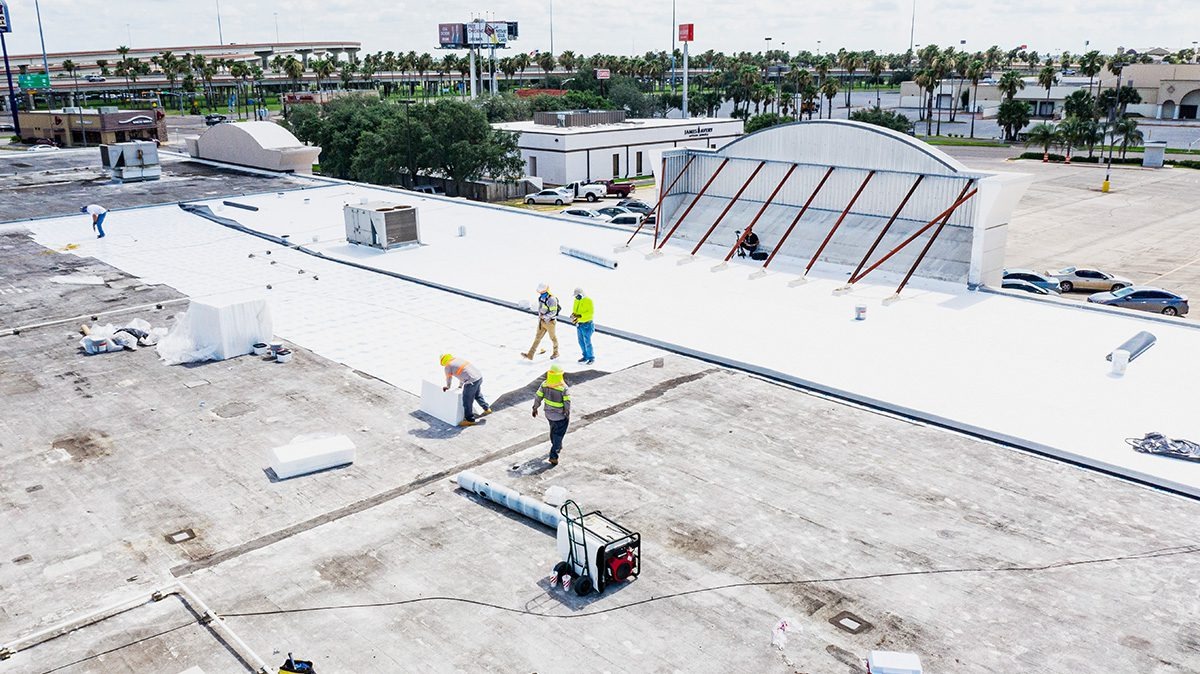
Commercial Drone Roof Inspection in Minneapolis, MN
What a Drone Sees on a Minneapolis Roof That a Walk Cannot
Stand in the parking lot of a distribution building off Hiawatha Avenue and the roof reads as a flat, blank deck. You cannot see the seam lifting at a far corner, the drain sitting in a ring of standing water, or the spot where an HVAC tech pulled a panel during a service call and never re-flashed it. Those small, boring failures are how commercial roofs actually die, and they hide in plain sight only because nobody can get eyes on them. We fly a consistent grid over the whole surface and bring every one of them into view at a resolution that lets us zoom in on individual fasteners and laps. For owners managing the large low-slope roofs Minneapolis is full of, that is a fundamentally different inspection than two people pacing the membrane for an afternoon.
The buildings that gain the most are the ones this market has in abundance. The warehouse and big-box stock near Hiawatha and along I-35W. The older manufacturing roofs in Northeast and the Mid-City Industrial belt. The institutional roofs on schools and municipal buildings with acres of single-ply between the parapets. On assemblies that size, a defect the size of a dinner plate can soak a wide field of insulation before anything ever drips inside, and catching it while it is still small is the entire point of flying it.
Thermal Imaging and the Physics of Trapped Moisture
The camera matters, but the sensor that earns its keep on a commercial roof is the thermal one. Water trapped inside a roof assembly stores and releases heat differently than the dry insulation around it. After a clear, sunny day, the saturated areas hold that absorbed heat and bleed it off slowly into the evening while the dry sections cool quickly. A thermal camera flown over the roof during that cool-down window reads the difference directly and maps the wet insulation as bright signatures glowing against a cooler background.
On Minneapolis roofs that capability is worth a great deal. A leak that slips through a failed seam in July can travel laterally through the insulation for months, and by January that trapped water is freezing, expanding and prying the assembly apart from the inside. By the time it finally stains a ceiling tile, the wet zone is usually many times larger than the entry point. Thermal imaging shows us the full footprint of saturated material instead of just the spot where gravity finally won, so the repair targets the actual damage rather than a guess.
- We fly thermal scans in the right conditions, typically in the evening after a clear day, when the temperature gap between wet and dry areas is at its strongest and the data is cleanest.
- We register the thermal anomalies against the visual imagery so each suspected wet area ties to a specific roof location and a feature you can point to.
- Where the stakes justify it, we confirm thermal findings with a core cut or a capacitance meter reading before anyone signs off on tear-off versus a spot repair.
Covering the Roof Without Anyone Setting Foot on It
Every step on a single-ply membrane carries a small cost. Foot traffic abrades the surface, grinds grit into the sheet, and concentrates load on areas that may already be compromised underneath. On a roof that is wet below but still intact on top, a walking inspection can be the very thing that finally punches through and turns a slow problem into an active leak.
Flying the roof takes that risk almost entirely off the table. We capture full visual and thermal coverage from the air, including parapets, drains, curbs and rooftop units, before we send anyone across the membrane and only then to the exact spots worth examining. For occupied buildings, where roof access means staging equipment through tenant space or across a busy site, it is also a logistics win. A facilities manager near the North Loop or on a tight lot just off downtown can get a complete roof condition report with almost no disruption to the operation below.
Part 107, Airspace, and Flying Legally Over Minneapolis
Commercial drone work is regulated, and we treat it that way rather than as an afterthought. Inspection flights are flown under the FAA's Part 107 rules for small unmanned aircraft, which govern who may operate, where, and under what conditions. Minneapolis layers real constraints on top of that. A large share of the metro sits inside the controlled airspace tied to Minneapolis-Saint Paul International, and many addresses downtown and along the river corridors require authorization before a drone ever leaves the ground.
We carry that load so you do not have to think about it. That means checking the airspace classification over your specific address, securing authorization where the airspace demands it, holding visual line of sight throughout the flight, and keeping clear of people and traffic below. On roofs sitting under the airport approach paths or inside restricted airspace, none of this is optional, and skipping it is exactly how an unqualified operator drags a property owner into a liability problem. Doing it correctly is simply part of what the service is.
Turning Aerial Data Into a Roof You Can Budget For
A folder of drone photos is not an inspection. The value lives in turning the imagery into decisions you can act on and dollars you can plan around. After each flight we produce a report that ties every finding to a location, separates the urgent leaks from the slow-developing wet areas, and gives you a clear, honest picture of where the roof actually stands.
For owners running several Minneapolis buildings, repeat aerial inspections become a genuine asset-management tool. Comparing scans year over year shows whether a wet area is holding steady or spreading, lets you schedule re-roofing capital before an emergency forces your hand, and builds a documented condition record for insurance and warranty purposes. A few defect patterns show up reliably on roofs in this climate, and we look for them specifically:
- Open or fishmouthed seams that admit meltwater through the long freeze-thaw season and then trap it under the membrane.
- Ponding near drains and low spots, which accelerates membrane breakdown on a flat roof and turns to structure-straining ice in winter.
- Lifted flashing along parapets and edges after the strong frontal systems that roll through the metro, often the first visible sign of a deeper securement failure.
- Failed details around rooftop units, vents and curbs, the busiest and most leak-prone part of any commercial roof.
Seeing those together, mapped across the entire roof, is what lets us tell the difference between a roof that needs a handful of targeted repairs and one that is approaching the end of its service life. That distinction is worth real money, and it is nearly impossible to make confidently from the ground.
Schedule a Drone Roof Inspection in Minneapolis
If you own or manage commercial property in Minneapolis and you want to know the true condition of your roof, including the moisture you cannot see from the ground or from a walking inspection, we can fly it. We handle the airspace authorization, the thermal and visual capture, and the reporting that turns it all into a plan you can use. Get in touch to schedule a single inspection or to set up a recurring program across your buildings.