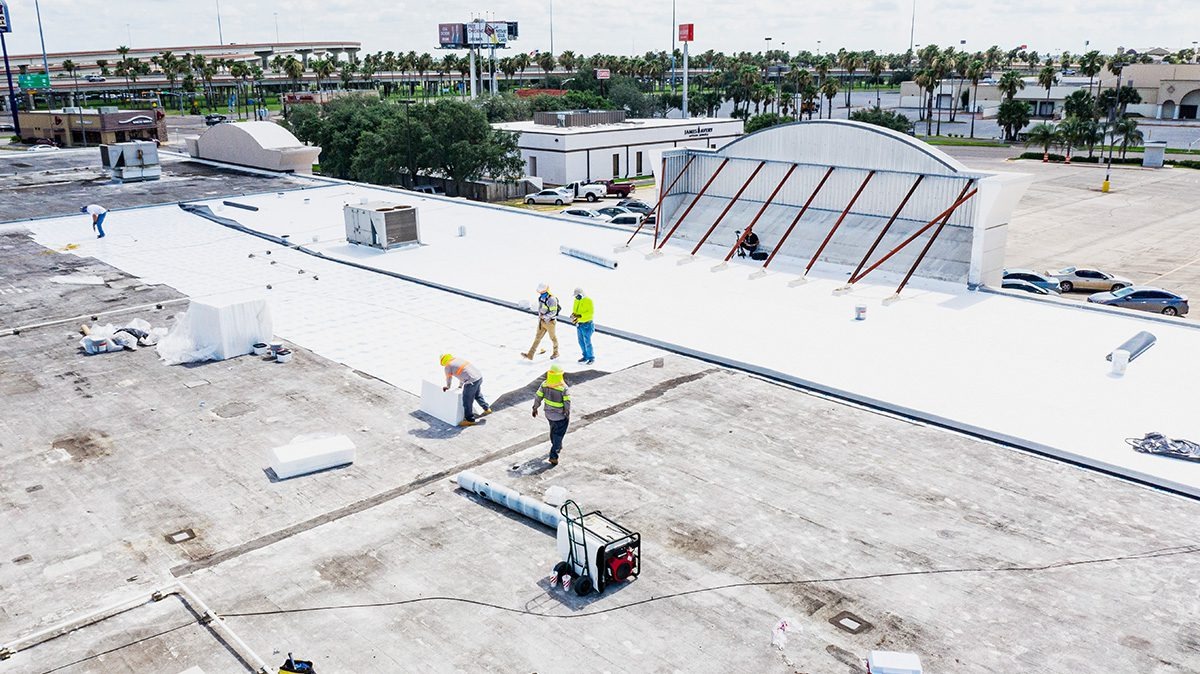
Industrial Roofing in Minneapolis, MN
Industrial Roofing for manufacturing facilities, warehouses, and industrial buildings throughout Minneapolis area.
Minneapolis industrial roofing is a fundamentally different discipline than what most Sun Belt contractors practice. When the temperature swings from negative 30 degrees Fahrenheit in January to 90 degrees in July, a roofing system doesn't just sit there weathering, it works. It expands, contracts, flexes at every seam and termination, absorbs snow load and then ice load as melt-refreeze cycles stack up, and does all of this under the additional stress of 54 inches of annual snowfall that can arrive in any month from October through April. We have been in this market long enough to know which systems survive those conditions and which ones produce callbacks after the first hard winter.
The I-494/I-694 industrial ring is the backbone of the Minneapolis-St. Paul metro industrial market, and the distribution centers, manufacturing plants, data centers, and logistics hubs that line it from Eagan and Burnsville in the south through Eden Prairie, Minnetonka, and Brooklyn Park in the west to Blaine and Maplewood in the north represent a massive concentration of low-slope roofing that needs ongoing professional attention. The buildings in this ring range from 1970s-era precast concrete construction with original coal tar pitch built-up roofing, systems that are performing remarkably well past their design life in some cases, to 2020s-era steel-frame distribution buildings with 60-mil TPO that is just entering its first decade of service.
Snow load management is not optional in Minneapolis industrial. A wet, heavy snowpack event can deliver design loads that challenge older structural systems, and the repeated loading and clearing cycles across a single winter create fatigue at drain attachment points, seam terminations, and perimeter flashings that doesn't show up as a leak until spring. We design drainage systems on Minneapolis industrial roofs with snow melting assumptions built in, scuppers and overflow drains sized for a fully blocked primary system, internal drain configurations that resist ice plugging, and where appropriate, heat trace on drain bodies and downspout tops to maintain drainage continuity during freeze events. An internal drain that ices over and blocks completely on a building with no overflow path creates a structural emergency.
Eagan and Bloomington are the data center and corporate distribution hub of the Twin Cities metro, and the roofing requirements for data center buildings differ from standard industrial in important ways. Penetration density is higher, mechanical, electrical, and telecommunications penetrations are far more numerous than on a standard distribution warehouse, and the consequences of water intrusion are catastrophic rather than merely expensive. We use pre-molded pipe boots rather than field-fabricated flashings on high-penetration-density data center roofs, install secondary containment flashings on critical penetration clusters, and provide as-built documentation that maps every penetration location for the facility management team's use in ongoing maintenance planning.
The Cottage Grove and Woodbury area east of Saint Paul, where 3M maintains significant research and manufacturing operations, is an industrial zone that presents chemical exposure considerations alongside standard roof maintenance needs. Buildings adjacent to chemical manufacturing and research operations can have roof-mounted exhaust systems discharging process chemicals that degrade certain membrane types over time. We assess the chemical environment and exhaust discharge locations before specifying membrane type and penetration sealing materials on these buildings. TPO membranes have known vulnerability to certain oils and petroleum derivatives; PVC membranes are more resistant in those environments but require different adhesive systems in cold-climate installation conditions.
Brooklyn Park and Brooklyn Center manufacturing represents a different slice of the Minneapolis industrial market, mid-size manufacturing plants, precision machining operations, medical device manufacturing, and similar uses that often operate in buildings with complex mechanical systems, high interior humidity from process operations, and multiple rooftop units that require coordinated maintenance access. The roofing contractor on these buildings needs to understand that a rooftop maintenance worker walking the roof to service HVAC equipment eight times a year for the building's life will put cumulative wear on the membrane surface at every unit, and the walkpad system around mechanical equipment needs to be designed for that traffic load, not just the initial installation inspection. We install proper walkpad systems as standard, not as an upgrade.
General Mills, Cargill, and Target distribution operations in the Twin Cities represent large-scale, professionally managed industrial real estate with sophisticated capital maintenance programs. These organizations have internal facilities management teams, multi-year maintenance budgets, and performance expectations that require contractor documentation, warranty administration, and service response capabilities that not every roofing contractor can provide. We operate at that level, written condition assessments, system-specific maintenance programs, documented inspection reports that feed their asset management databases, and warranty claims support when manufacturer warranty issues arise. Industrial roofing for institutional property managers is a relationship and a documentation discipline as much as it is a craft trade.
Cold-climate roofing assembly design gets a lot of things right in the spec but wrong in the field when the contractor doesn't understand vapor drive. In Minneapolis, the vapor drive is from inside out for the majority of the heating season. That means the vapor retarder belongs on the warm side of the insulation assembly, typically the deck surface, and every penetration through the vapor retarder plane must be sealed to prevent warm, moist interior air from bypassing the retarder and condensing within the insulation. On manufacturing buildings with process humidity, food processing, laundry, certain chemical operations, this vapor management is critical. We've investigated moisture damage in Minneapolis industrial roof assemblies that was caused entirely by inadequate vapor retarder detailing rather than any membrane failure.
Minneapolis-St. Paul International Airport cargo operations and the industrial zone around it are constrained by FAA height restrictions and the logistical reality of working in a high-security, high-activity airport environment. We know this zone and have worked in it under the coordination requirements that apply to crane and aerial equipment operations near MSP. The industrial park extends into the Eagan and Mendota Heights areas east and south of the airport, and those facilities have their own access protocols that we manage as part of standard project coordination. If your facility is in the airport influence area, start the pre-construction coordination early, the approval and permit timeline in restricted zones adds weeks to a project schedule and shouldn't be a surprise when you're trying to complete a reroof before October closes the practical construction window in Minnesota.
For large industrial distribution centers on the I-494/I-694 ring, mechanically fastened 60-mil TPO is the most common and durable choice, but the installation details matter as much as the membrane specification. In cold climates, TPO seam welds need to be performed within manufacturer temperature parameters, field welding in temperatures below 40 degrees Fahrenheit requires supplemental heat and careful quality control to achieve consistent seam strength. EPDM is also a strong performer in cold climates and is more forgiving of cold-weather seam work because it uses adhesive bonding rather than heat welding, though its dark surface requires ballast or topcoat for UV protection. For buildings with significant thermal cycling from interior heat generation, we pay close attention to perimeter and corner fastening patterns to manage the differential movement between the membrane and the deck.
Preventing ice blockage of roof drains in Minneapolis requires addressing the problem at the drain design level, not just hoping the membrane survives ponding. Our standard approach includes specifying roof drains with built-in electric heat trace capability, installing overflow scuppers or secondary drains sized to handle full design rainfall flow assuming the primary drain system is completely blocked, and using interior dome drain guards rather than exterior projecting domes that ice over and block. On buildings with heated interior spaces, ensuring adequate insulation above the drain body so that the drain area stays above freezing is also critical, a cold drain in a warm roof assembly is an ice dam waiting to happen. For buildings that have persistent drain blocking history, we sometimes recommend increasing drain count and decreasing the drainage area each drain serves.
Winter roofing work in Minneapolis is possible but limited to specific system types and requires careful quality control. Self-adhering modified bitumen systems and fully adhered EPDM are more practical in cold conditions than hot-process systems or heat-welded TPO. Below about 25 degrees Fahrenheit, most adhesives require warming before application, and membrane flexibility decreases significantly. We generally recommend scheduling major industrial reroof projects for May through October to avoid cold-weather installation restrictions. For emergency situations, storm damage, catastrophic membrane failure, we can install temporary protection and certain permanent systems year-round with proper material conditioning and quality protocols. If your building needs a roof before next spring, call us and we'll give you an honest assessment of what's feasible in current conditions.
White mineral deposits on exterior walls below roof drains are typically caused by water carrying dissolved salts from the concrete roof deck or insulation board, or from the leaching of alkaline compounds from built-up roofing systems, flowing through the drain and down the building exterior. In Minneapolis, this often becomes visible in spring when snowmelt is running through drains for extended periods. The staining itself is usually cosmetic, but it can indicate that drain connections have small gaps where water is bypassing the drain bowl and infiltrating the wall assembly. We check drain body connections and overflow path integrity during every inspection on Minneapolis industrial buildings where this pattern is present. In some cases, the issue is a cracked drain body or a failed connection to the interior drain leader that requires plumbing work above the roofing scope.
Chemical exhaust discharge on or near roofing membranes requires identifying the chemical composition of the exhaust stream before selecting membrane type and penetration sealing materials. Petroleum hydrocarbons, certain solvents, and oxidizing agents can degrade TPO and EPDM membranes at different rates depending on concentration and contact frequency. PVC membranes have better chemical resistance to certain compound classes but are less flexible in cold temperatures and require careful cold-weather installation management in Minnesota. For exhaust stacks discharging known problem chemicals, we specify a zone of chemically compatible membrane around the stack with appropriate transition detailing to the main roof membrane system. We may also specify a stainless steel or aluminum curb extension on the stack to direct exhaust discharge above the membrane surface rather than directly onto it.
How do I know if my Minneapolis BUR roof needs repair or full replacement?
The decision turns on moisture saturation in the insulation layer. If core sampling shows wet insulation in more than 25% of the roof area, replacement is typically more cost-effective than recover, saturated insulation has to be removed regardless, and at that percentage the removal and disposal cost closes the gap between recover and replacement. If wet areas are under 25%, we cut out the wet insulation, replace it, and recover the system. We document every core pull and give you the data to make the decision, we do not make a replace recommendation on surface condition alone.
Can you work on BUR roofs in Minneapolis winters?
Repair and maintenance work on BUR systems can be done in winter with appropriate materials, modified bitumen torch patches, cold-applied sheet materials rated for cold-temperature application, and peel-and-stick flashing products that maintain bond at low temperatures. Hot-mop BUR installation (new multi-ply systems installed with a kettle and hot bitumen) requires substrate temperatures above the minimum specified by the bitumen manufacturer, typically 40°F for the substrate, not ambient, which limits full-system installation to the warmer months. Emergency dry-in work in winter uses temporary materials that are replaced when conditions allow.
Does working on an existing BUR system require special disposal procedures?
Older BUR systems, particularly those installed before 1975, may contain asbestos-containing materials in the ply felts or the bitumen compound. We require an asbestos survey prior to any core sampling or tear-off on BUR systems that predate 1975. The survey is the building owner's responsibility, but we can coordinate with qualified industrial hygienists in the Minneapolis market. Asbestos-containing BUR systems require abatement by a licensed asbestos contractor before roofing work proceeds, this adds time and cost to the project scope and needs to be in the project plan before contract signing.