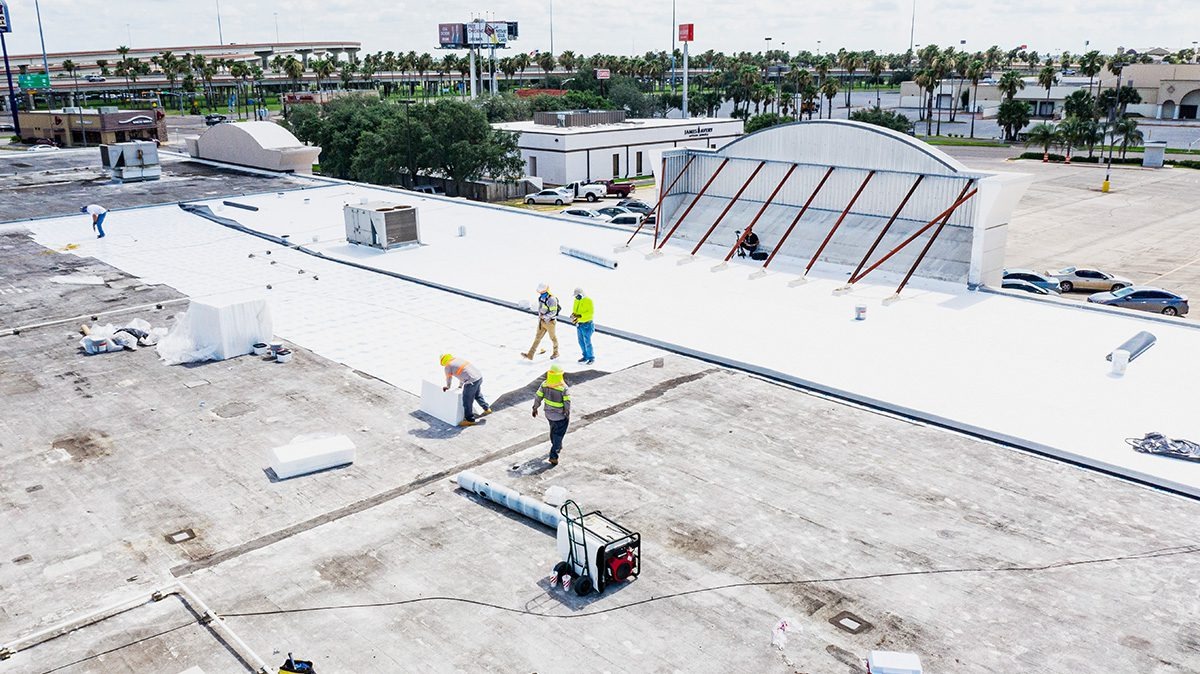
Commercial Parapet Wall Repair in Minneapolis, MN
Parapet walls are the single highest-failure-rate detail on Minneapolis commercial flat roofs. Ice jacking, freeze-thaw cycling, and thermal movement at the wall-to-membrane transition fail parapet flashings in ways that produce chronic leaks, not one-time events.
Every commercial flat roof in Minneapolis terminates at a parapet wall. The parapet is the upturned edge, the short wall that runs around the building perimeter, and its condition determines whether the roof membrane system functions as a whole or fails at its edges. In Minnesota, that edge is under extraordinary stress: ice forms in the gap between the counterflashing and the wall face, expands on freezing, and mechanically separates the flashing from the masonry. The next melt cycle sends water into that gap. Repeat for 30 to 50 freeze-thaw cycles per winter over multiple decades, and the parapet flashing fails.
The failure mode is well understood. What is less well understood by many Minneapolis building owners is that parapet failure is a chronic, progressive condition, it does not produce an acute interior leak on the first failed freeze-thaw cycle. Water infiltrates the insulation behind the counterflashing, saturates a zone of polyiso over multiple seasons, migrates laterally through the insulation, and eventually exits through a deck penetration. By the time the ceiling stain appears in March, the parapet section above may have been admitting water for two or three winters.
Our parapet repair work covers every component of the parapet assembly: coping cap flashing, counterflashing (the metal or composite element embedded in the masonry joint), the base flashing membrane turn-up, the masonry or concrete parapet wall face, and the wall-to-roof transition. On North Loop warehouse buildings with unreinforced brick masonry parapets from the 1920s to 1940s, that sometimes means coordinating with a structural mason on parapet wall stabilization before the flashing system is repaired.
Parapet Components We Repair and Why Each Fails in Minneapolis
Coping cap flashing: The coping cap sits at the top of the parapet wall and sheds water off both faces. In Minneapolis, coping cap joints, the expansion joints between individual cap sections, are the primary failure point. Thermal movement over a Minneapolis temperature range of roughly 120°F (from -25°F in January to 95°F in July) causes the cap sections to expand and contract. Rigid sealant at the cap joints cracks within 3 to 5 years. Factory-formed flexible cap joint covers with compressible backer rod are the correct detail, we install them and avoid the caulk-only joint that most prior repairs used. On brick masonry buildings, we also tuckpoint the mortar bed under the coping where water has been infiltrating and freezing behind the cap.
Counterflashing: Counterflashing is the metal element reglet-cut into the masonry wall face and bent down over the top of the base flashing turn-up. In Minneapolis, the counterflashing-to-masonry joint fails in two ways: the mortar in the reglet joint deteriorates under freeze-thaw cycling and releases the top edge of the counterflashing, and the sheet metal itself fatigues at the bend line from thermal movement. We re-set loose counterflashing sections, repoint the reglet joint with non-shrink mortar, and replace fatigued metal sections with compatible gauge material.
Base flashing membrane turn-up: The base flashing is the roofing membrane turned up the parapet wall face, the vertical component that bridges the roof plane to the parapet. In Minneapolis, base flashing height below the seasonal snow depth is the single most common parapet repair driver. Code requires a 4-inch minimum turn-up height; Minneapolis snowpack can run 30 to 48 inches in a heavy year. We extend base flashing turn-ups to 8 inches above the building's design snow depth as a repair standard, not a code minimum.
Masonry parapet wall face: Unreinforced brick masonry parapets on North Loop and Northeast Minneapolis warehouse buildings from the 1920s to 1950s have had decades of freeze-thaw cycling working on the mortar joints and brick face. Spalled brick, open mortar joints, and horizontal cracks at the masonry bond beam level are all conditions we document during parapet inspection. Tuckpointing open joints, repointing with Type S or Type N mortar appropriate to the original construction, is a necessary step before the counterflashing repair, or the counterflashing repair will fail from water infiltration at the masonry face within 2 to 3 seasons.
Ice-Jacking Remediation, The Minneapolis-Specific Failure Mode
Ice jacking occurs when water infiltrates the gap between the counterflashing face and the masonry wall, freezes, expands, and mechanically lifts the counterflashing away from the wall. The expansion force of freezing water is approximately 2,000 psi, more than sufficient to fail a mechanically fastened counterflashing joint or crack a mortar reglet. After the ice melts, the counterflashing does not spring back to its original position. The gap is now wider, admits more water on the next infiltration event, and the damage escalates each winter.
Remediation: We address ice jacking by reinstalling the counterflashing with a flexible detail that accommodates thermal movement without creating a gap, a compressible foam backer rod behind the sealant joint instead of a rigid-sealant-only detail, and a closed-cell foam strip between the counterflashing leg and the masonry face to prevent the water accumulation that initiates the jacking cycle. On buildings where the ice jacking has displaced the counterflashing far enough to create a structural repair need, we coordinate with a licensed structural mason.
Prevention through snow management: On buildings where the parapet geometry creates a drift accumulation zone, the downwind parapet on a Minneapolis building catches drift from prevailing northwest winds, we incorporate rooftop snow management into the maintenance contract. Removing drift accumulation before it creates the ice dam mass that drives jacking reduces the repair frequency on vulnerable parapet sections.
How do I know if my Minneapolis building's parapet flashing needs repair?
Visible indicators: coping cap sections that have shifted horizontally from their original position, open mortar joints in the masonry wall face above the roof line, water stains on the interior face of the parapet wall below the roof line, ceiling stains in spaces adjacent to exterior walls during late winter or spring melt-out, and counterflashing sections that have pulled away from the masonry face. Any of these warrants a parapet inspection before the next winter.
Can parapet wall repair be done in winter in Minneapolis?
Membrane base flashing repair using modified bitumen can be done at temperatures well below zero. Masonry tuckpointing requires above-freezing temperatures (typically above 40°F for Type S mortar) with protection against frost. Coping cap joint resealing with polyurethane sealant requires substrate temperatures above the sealant manufacturer's application minimum (typically 40°F). We sequence parapet repair work around temperature windows and use heated enclosures on winter projects where the scope requires masonry work.
Do you coordinate with structural engineers or masons for parapet repairs?
Yes, when the scope requires it. Unreinforced brick masonry parapets on North Loop and Northeast Minneapolis warehouse buildings sometimes need a structural mason's assessment before flashing repair, we coordinate that relationship. For parapet sections where structural assessment indicates the wall itself needs stabilization before flashing work can proceed, we scope the masonry work as a separate line item and manage the project sequence.