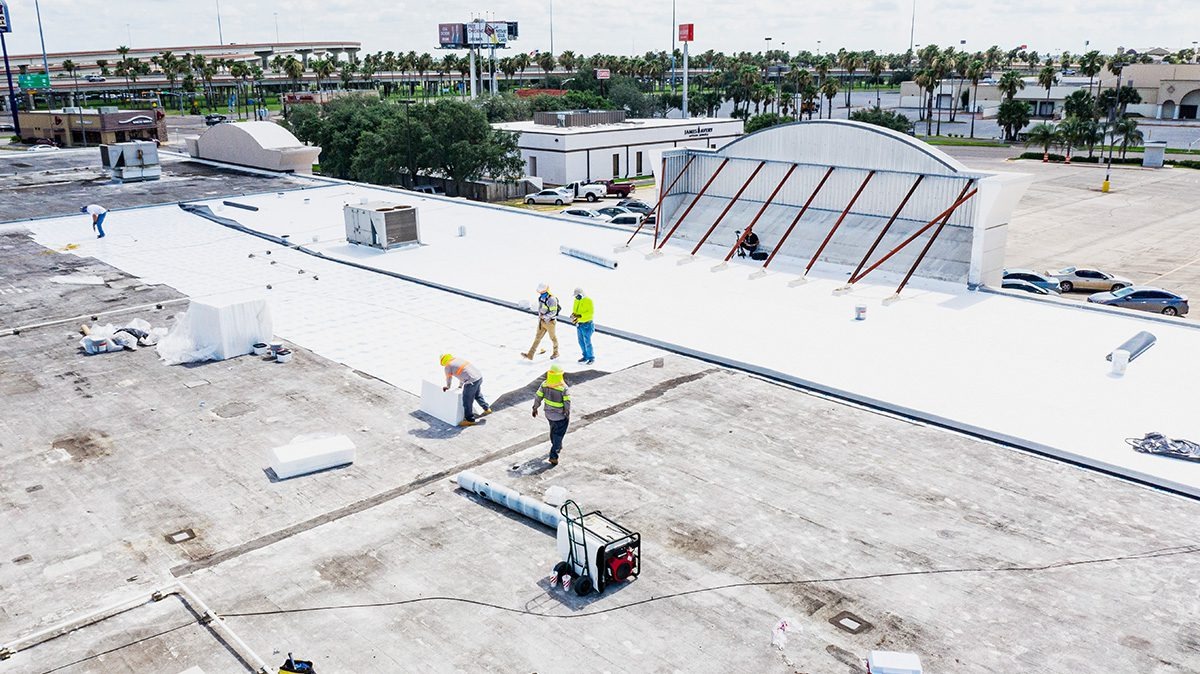
Restaurant and Food Service Building Roofing in Minneapolis, MN
Commercial roofing for restaurants, quick-service chains, breweries, and food service facilities throughout Minneapolis, MN.
Minneapolis operates one of the most active restaurant scenes in the Upper Midwest, from the dense taco and pupusa counters along Lake Street and the Northeast Minneapolis brewery corridor to the downtown skyway-connected restaurants that keep volume flowing even when wind chills drop to minus twenty. Every one of those food-service buildings carries a flat or low-slope roof that is asked to perform through climate conditions that rank among the most demanding on the continent, and the roofing decisions made during a re-roof project have consequences that last two decades or more.
The twin enemies of a Minneapolis restaurant roof are ice dams and thermal shock. Unlike residential ice dams that form at heated eaves, commercial flat roofs in Minneapolis develop ice pools in low spots and at blocked drains when daytime thawing refreezes overnight. A restaurant kitchen generating continuous heat through an attached HVAC system creates uneven snowmelt patterns across the roof that channel water toward drains that may be partially blocked by ice. Keeping interior roof drains and their associated overflow scuppers clear through the heating season is a maintenance task that Minneapolis food-service operators cannot delegate and forget.
Grease exhaust penetrations on Minneapolis restaurant roofs experience a failure mode specific to cold climates: grease that remains liquid during service hours congeals as temperatures drop overnight and the exhaust fan cycles off. That congealed grease holds ice against the flashing collar through the winter, and repeated freeze and thaw cycles crack the elastomeric sealant that creates the watertight transition between the exhaust stack and the membrane. The Northeast Minneapolis brewpub strip and the fast-casual restaurants in Uptown see this failure pattern consistently, and experienced contractors address it during re-roofing by switching to pourable urethane sealants that retain flexibility at sub-zero temperatures rather than standard silicone.
Walk-in cooler and freezer curbs present a vapor management challenge in Minneapolis that is more pronounced than in any Sunbelt market. In January, with ambient temperatures at minus fifteen and a walk-in freezer holding at minus ten, the thermal gradient across the roof assembly creates strong vapor drive toward the cold side. Improperly placed vapor retarders allow warm, moist kitchen air to migrate upward and condense within the insulation, saturating polyiso boards silently over multiple heating seasons. By the time a restaurant owner notices ceiling tile staining in the walk-in area, the insulation above may already be holding dozens of gallons of absorbed moisture. Proper re-roofing eliminates that moisture and installs a vapor retarder at the correct position in the assembly based on Minneapolis climate zone calculations.
The Eat Street corridor on Nicollet Avenue, the food halls in the North Loop, and the growing number of full-service taprooms in the Longfellow neighborhood all share one operational reality: they cannot close for extended periods. Minneapolis restaurant roofing contractors who specialize in food-service work phase projects to allow continuous kitchen operation, scheduling tear-off over sections after last call and installing temporary waterproofing before morning prep begins. That kind of operational coordination requires clear communication with kitchen management, understanding of HVAC interdependencies when rooftop units are temporarily taken offline, and crews that are willing to work the overnight window rather than standard day shifts.
TPO membranes dominate the Minneapolis commercial roofing market for food-service buildings largely because of their documented performance in cold-climate applications and the strong local contractor base trained on their installation. A 60-mil TPO system with polyiso insulation above a recovery board on an existing deck offers Minneapolis restaurants the thermal performance needed to satisfy Minnesota energy code while maintaining weld quality that holds through the winter. Installers here know to use heat guns calibrated for cold ambient conditions and to increase weld overlap widths when temperatures during installation fall below 40 degrees Fahrenheit.
Health and safety inspections by Hennepin County Environmental Health cover not only kitchen equipment and food handling but also physical plant conditions that affect food safety. A Minneapolis inspector who finds mold growth on a walk-in cooler ceiling, ceiling tiles discolored from active leaks, or evidence of pest entry through deteriorated roof-level penetrations will issue citations that require documented repair before re-inspection. Roofing contractors who have previously worked with Minneapolis restaurant operators on code-compliance repairs understand how to prepare the written documentation and photo records that the county requires to close a deficiency citation, making the re-inspection process faster and less stressful.
Older commercial buildings in neighborhoods like Dinkytown, Lyn-Lake, and South Minneapolis that have been converted to restaurants or brewpubs often present unexpected deck conditions during tear-off. Buildings constructed in the 1920s through 1950s may have original wood plank decks covered by multiple layers of built-up roofing, and water infiltration over decades can have caused significant deck deterioration concentrated around drain locations and parapet walls. Minneapolis contractors experienced in food-service re-roofing budget for deck repair as a contingency item rather than an unknown, and they have both the lumber and the concrete repair materials on-site to address soft spots without stopping the project timeline.
Franchise QSR operators along Central Avenue NE, the Penn Avenue corridor in North Minneapolis, and the commercial clusters near the University of Minnesota campus navigate lease requirements, franchise corporate standards, and Minnesota building code simultaneously when scheduling a re-roof. The Minnesota Department of Labor and Industry requires licensed contractors and specific permit documentation for commercial roofing, and a contractor who understands all three layers of requirement can prepare a compliant scope document that satisfies the franchisor's warranty requirements, the building owner's insurance specifications, and the state permit office in a single submittal, eliminating the back-and-forth that delays project approvals by weeks.
How do I know if my Minneapolis BUR roof needs repair or full replacement?
The decision turns on moisture saturation in the insulation layer. If core sampling shows wet insulation in more than 25% of the roof area, replacement is typically more cost-effective than recover, saturated insulation has to be removed regardless, and at that percentage the removal and disposal cost closes the gap between recover and replacement. If wet areas are under 25%, we cut out the wet insulation, replace it, and recover the system. We document every core pull and give you the data to make the decision, we do not make a replace recommendation on surface condition alone.
Can you work on BUR roofs in Minneapolis winters?
Repair and maintenance work on BUR systems can be done in winter with appropriate materials, modified bitumen torch patches, cold-applied sheet materials rated for cold-temperature application, and peel-and-stick flashing products that maintain bond at low temperatures. Hot-mop BUR installation (new multi-ply systems installed with a kettle and hot bitumen) requires substrate temperatures above the minimum specified by the bitumen manufacturer, typically 40°F for the substrate, not ambient, which limits full-system installation to the warmer months. Emergency dry-in work in winter uses temporary materials that are replaced when conditions allow.
Does working on an existing BUR system require special disposal procedures?
Older BUR systems, particularly those installed before 1975, may contain asbestos-containing materials in the ply felts or the bitumen compound. We require an asbestos survey prior to any core sampling or tear-off on BUR systems that predate 1975. The survey is the building owner's responsibility, but we can coordinate with qualified industrial hygienists in the Minneapolis market. Asbestos-containing BUR systems require abatement by a licensed asbestos contractor before roofing work proceeds, this adds time and cost to the project scope and needs to be in the project plan before contract signing.