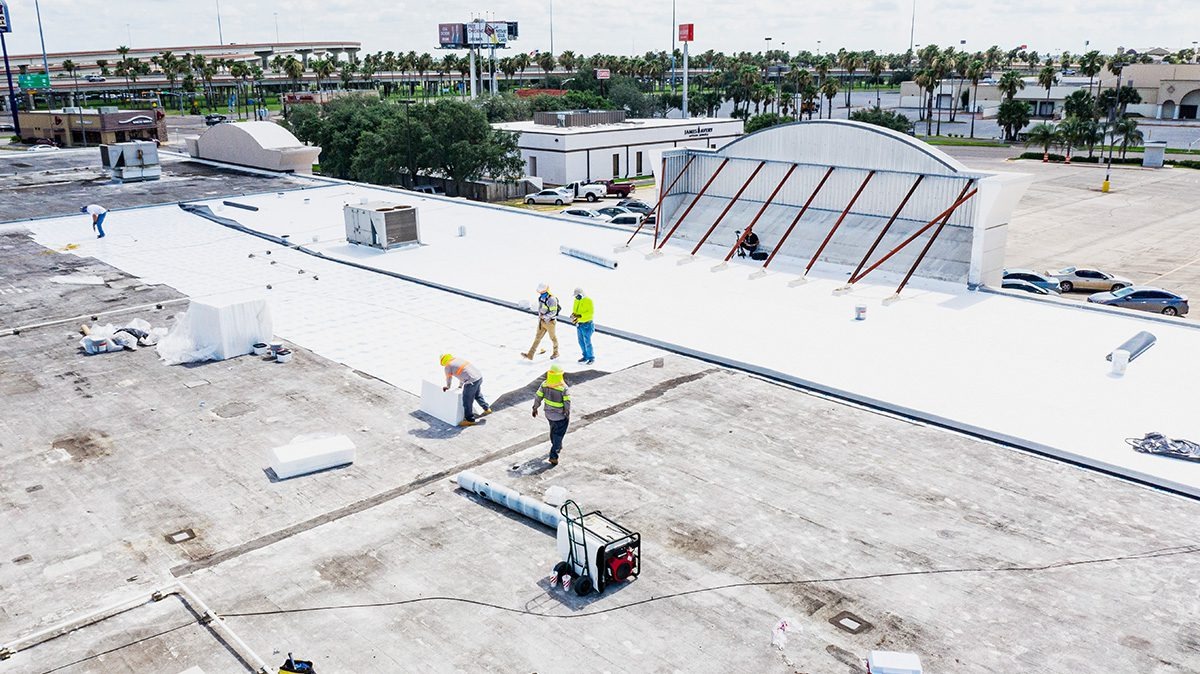
Retail and Shopping Center Roofing in Minneapolis, MN
Commercial roofing for strip malls, shopping centers, anchor stores, and standalone retail buildings throughout Minneapolis, MN.
Minneapolis retail real estate spans a remarkably broad spectrum,from the enclosed regional malls that pioneered the climate-controlled shopping environment (the Mall of America in neighboring Bloomington is the nation's largest) to the dense urban retail corridors along Nicollet Mall, Lake Street, and Hennepin Avenue, and extending through the suburban strip mall and power center clusters that line corridors like Excelsior Boulevard in St. Louis Park, France Avenue in Edina, and County Road 42 in the expanding southern suburbs. What all of these commercial retail properties share is the defining challenge of Minnesota's climate: winters that rank among the most extreme of any major American metro, with snowfall, ice, and sub-zero temperatures that demand roofing systems and maintenance programs calibrated for conditions that Southern and even Central Midwestern markets never face.
Minnesota's building code snow load requirements are among the highest in the continental United States, reflecting the consistent and sometimes extraordinary snowfall that the Twin Cities receives in significant winters. Large retail rooftops,anchor stores, grocery-anchored shopping centers, and the big-box formats that define suburban Minneapolis retail,carry enormous shed areas that can accumulate significant structural loads during heavy snowfall periods. Property managers must maintain active rooftop snow monitoring programs, with established protocols for when removal is required based on the specific structural design capacity of each building. Older strip plazas along corridors like West Broadway Avenue in North Minneapolis or Cedar Avenue in the southern suburbs may have lower structural capacities than current code requires, making professional engineering assessment a prerequisite for responsible ownership.
TPO roofing systems are the standard specification for Minneapolis commercial retail construction and replacement work, primarily because TPO's cold-temperature flexibility prevents the brittleness failures that affect less suitable systems in Minnesota winters. Cold-weather TPO installation is technically demanding, and Minneapolis commercial roofing contractors who work year-round must maintain the equipment and crew expertise to produce compliant welds when ambient temperatures are in single digits. For property owners who have the scheduling flexibility, confining major re-roofing projects to the May through September installation window provides the most consistent quality conditions. For emergency repairs during winter, an experienced contractor with proper cold-weather protocols is essential,a poor cold-weather weld on an emergency repair fails again within weeks, requiring a second mobilization and doubling the cost.
Minneapolis's freeze-thaw cycling, particularly during the transition months of October, November, March, and April, creates the most aggressive flashing deterioration conditions of any season. Temperature oscillations that cross the freezing point multiple times within a single week force ice into every marginal joint, seam, and flashing edge,a mechanical deterioration process that is far more damaging than the sustained cold of January, when temperatures stay below freezing and water doesn't have the opportunity to infiltrate. A comprehensive fall inspection in late September or early October,identifying and repairing every suspect transition detail before the first sustained freeze,is the most cost-effective maintenance practice in the Minneapolis market. Every dollar spent on pre-winter repairs typically prevents three to five dollars in post-winter emergency repair costs.
HVAC systems on Minneapolis retail rooftops operate in a thermal environment that requires detailed cold-weather design attention. Condensate lines must discharge to heated interior drain connections rather than to the roof surface, where they will freeze and force backed-up water under curb flashings during extended cold periods. Curb heights must be adequate to remain above snow accumulation,12 inches minimum is standard practice for the Minneapolis market, with some roof configurations warranting taller curbs. Equipment vibration isolation and seismic anchoring that meets Minnesota's applicable requirements keeps units secure through freeze-thaw cycles that can loosen anchors over time. A full HVAC penetration audit before any major re-roofing project on a Minneapolis retail property establishes the baseline condition and scope for the penetration work that any competent re-roofing project must address.
The Southdale area in Edina,home to the nation's first enclosed shopping center,and the surrounding France Avenue commercial corridor represent some of the Twin Cities' most valuable retail real estate. The institutional landlords and REITs managing properties in this corridor apply sophisticated roofing standards: manufacturer-certified annual inspections, infrared moisture mapping on a regular cycle, and documented capital reserve planning. Suburban strip mall owners in the broader Minneapolis metro can apply the same systematic approach at a scale appropriate to their portfolios. The discipline of annual inspection, documented repairs, and reserve budgeting is not an institutional luxury,it's a practice that pays for itself in reduced emergency repair costs and preserved asset value for any retail property owner.
Spring snowmelt on Minneapolis retail rooftops creates a hydraulic challenge that distinguishes the market from any Sun Belt or even mid-latitude market. When warm air finally breaks Minnesota's winter in late March or April, accumulated snowpack can release very large volumes of melt water in a short period, particularly when rain coincides with the melt event. Roof drainage systems that are adequate for summer thunderstorm events may be insufficient for peak snowmelt conditions if primary drain capacity is reduced by ice blockage or debris accumulation under the snow cover. Verifying that drains are clear and that overflow scuppers are unobstructed immediately after winter,before the primary melt window arrives,is a critical spring maintenance step for Minneapolis retail property managers.
Retail brand standards create a consistent coordination requirement for Minneapolis landlords whose properties include national tenants. Chains anchoring retail strips along major suburban corridors bring prototype specifications that govern everything from parapet coping details to rooftop unit screening configurations. The Edina, Eden Prairie, and Maple Grove retail clusters,all home to significant national tenant concentrations,see these coordination requirements on nearly every re-roofing project. Establishing clear communication channels between the landlord's roofing contractor and each major tenant's facilities team before project mobilization prevents the costly change orders that arise when brand-required details aren't incorporated into the original project scope.
Minneapolis retail property owners who maintain documented, warranted roofing systems are increasingly advantaged in transactions, lease renewals, and financing reviews. The Minneapolis commercial real estate market has significant institutional activity,REITs, pension funds, and regional investment groups all active in the Twin Cities retail sector,and institutional buyers conduct thorough roofing due diligence as part of acquisition. Properties with clean roofing documentation, active manufacturer warranties, and evidence of annual maintenance present fewer surprises in due diligence and typically clear the property condition review faster than those with deferred maintenance and documentation gaps. For retail landlords who plan to hold and eventually sell Minneapolis assets, maintaining the roofing documentation file is a direct investment in the eventual transaction outcome.
How do I know if my Minneapolis BUR roof needs repair or full replacement?
The decision turns on moisture saturation in the insulation layer. If core sampling shows wet insulation in more than 25% of the roof area, replacement is typically more cost-effective than recover, saturated insulation has to be removed regardless, and at that percentage the removal and disposal cost closes the gap between recover and replacement. If wet areas are under 25%, we cut out the wet insulation, replace it, and recover the system. We document every core pull and give you the data to make the decision, we do not make a replace recommendation on surface condition alone.
Can you work on BUR roofs in Minneapolis winters?
Repair and maintenance work on BUR systems can be done in winter with appropriate materials, modified bitumen torch patches, cold-applied sheet materials rated for cold-temperature application, and peel-and-stick flashing products that maintain bond at low temperatures. Hot-mop BUR installation (new multi-ply systems installed with a kettle and hot bitumen) requires substrate temperatures above the minimum specified by the bitumen manufacturer, typically 40°F for the substrate, not ambient, which limits full-system installation to the warmer months. Emergency dry-in work in winter uses temporary materials that are replaced when conditions allow.
Does working on an existing BUR system require special disposal procedures?
Older BUR systems, particularly those installed before 1975, may contain asbestos-containing materials in the ply felts or the bitumen compound. We require an asbestos survey prior to any core sampling or tear-off on BUR systems that predate 1975. The survey is the building owner's responsibility, but we can coordinate with qualified industrial hygienists in the Minneapolis market. Asbestos-containing BUR systems require abatement by a licensed asbestos contractor before roofing work proceeds, this adds time and cost to the project scope and needs to be in the project plan before contract signing.