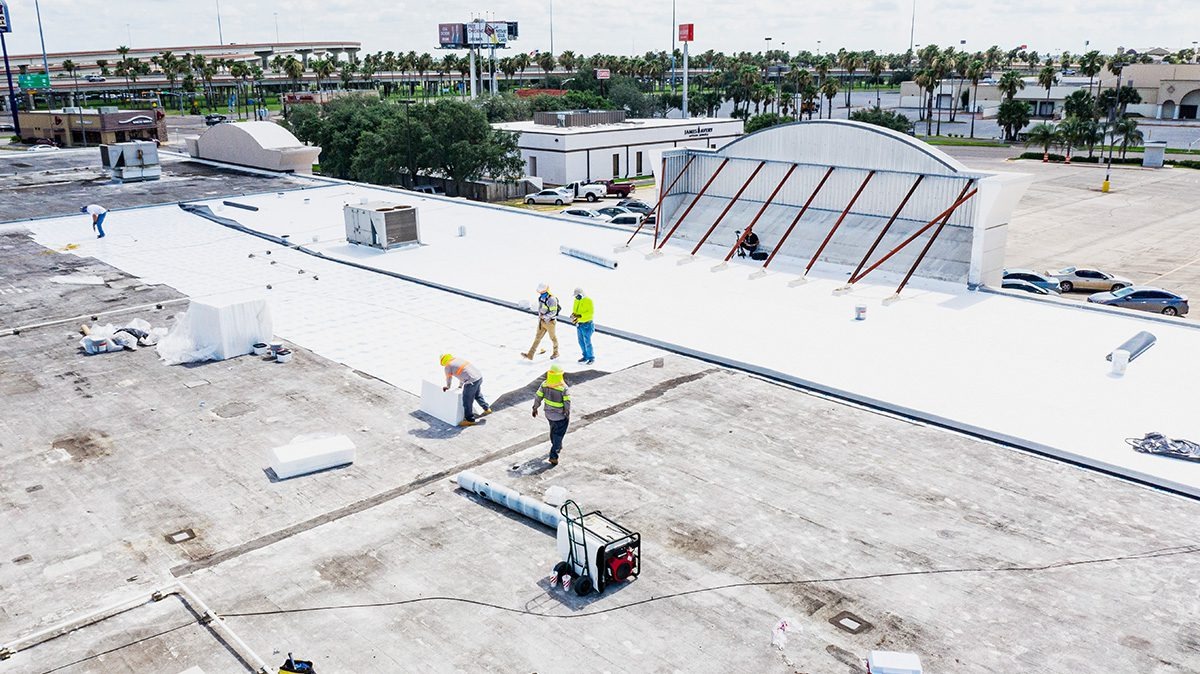
Silicone Roof Coating in Minneapolis, MN
Silicone roof coating applied correctly extends a Minneapolis commercial roof's service life by 10 to 15 years at roughly 20 to 30% of replacement cost. Applied incorrectly, over wet insulation or unprepared substrate, it traps moisture and accelerates the failure it was supposed to prevent.
Silicone roof coating has become one of the most marketed products in the commercial roofing industry, and the marketing is not always honest about what the system does and does not do. A silicone coating is a fluid-applied waterproofing membrane, typically 20 to 40 mils dry film thickness, that bonds to the existing roof surface and provides a new waterproofing layer. It is not a structural repair. It does not fix saturated insulation. It does not restore the R-value of a degraded insulation system. And it does not substitute for correct base flashing at parapets and penetrations.
What silicone coating does well, genuinely well, and particularly in Minneapolis's climate, is extend the service life of a structurally sound roof that has a degraded surface. UV degradation on a TPO membrane that has lost its plasticizers and developed surface micro-cracking, lap seams on an EPDM system that have lost their factory bond, granule loss on a modified bitumen cap sheet that exposes the bitumen compound to direct UV: these are conditions where silicone coating, properly applied over a prepared surface, provides a cost-effective service life extension. We have coated Minneapolis commercial roofs in the Elliot Park neighborhood, the Seven Corners area near the University of Minnesota West Bank, and along the Washington Avenue industrial corridor where the building owners needed to extend service life to align with capital budgets.
Our silicone coating scope begins with a moisture survey, we will not apply coating over wet insulation. We pull cores at suspect locations and run infrared after sunset if the roof is large enough to warrant it. Wet areas get cut out and dried before coating proceeds. Surface preparation, pressure washing at minimum, mechanical abrasion at lap seams and repaired areas, is not optional. The coating adhesion failure that shows up in Minneapolis winters traces back to inadequate surface preparation, not to the silicone product.
When Silicone Coating is the Right Call for a Minneapolis Roof
TPO and EPDM membranes with surface degradation but intact insulation and sound deck: This is the core use case for silicone coating on Minneapolis commercial buildings. A 2005-era TPO system on a Northeast Minneapolis warehouse that has lost surface reflectivity, shows lap seam lifting in isolated areas, and has two or three repaired punctures but no systemic moisture infiltration, that roof is a good silicone coating candidate. The coating restores the waterproofing layer, improves the reflectivity to better-than-new TPO performance (silicone at 40 mils DFT reflects 80 to 85% of solar radiation), and adds 10 to 15 years to the service life at roughly a third of the cost of a new TPO recover.
Modified bitumen roofs with surface granule loss and isolated alligatoring: Silicone coating over modified bitumen requires a thorough primer application, silicone does not bond directly to all bitumen formulations without priming, and mechanical repair of any alligatored areas before coating. When done correctly, the coating encapsulates the repaired surface and provides UV protection that slows the deterioration of the underlying bitumen compound.
Metal roofs with lap joint and sealant deterioration: Standing seam and through-fastened metal roofs with deteriorated lap sealant and fastener-area corrosion are silicone coating candidates, the fluid-applied coating bridges the joint gaps and fastener holes that allow water infiltration. Minneapolis metal roof applications use silicone formulations with added fiberglass reinforcement fabric at the fastener rows and lap seams for additional puncture resistance and bridging capacity.
Application Conditions for Minneapolis Silicone Coating Work
Temperature and humidity limits for silicone coating application in Minneapolis dictate the project schedule more than almost any other roofing product. Most silicone coatings require substrate temperatures above 40°F and rising, not ambient temperature, substrate temperature, and relative humidity below 90% at the time of application. Minneapolis's April and October application windows are narrow; the typical application season runs May through September for optimal results. We do not apply silicone coating in threatening weather, rain within 4 to 6 hours of application washes uncured silicone off the substrate, creating a waste and bonding problem that requires full reapplication.
Surface moisture is the other critical variable. The substrate must be dry to the touch and below the manufacturer's specified moisture content, we check with a moisture meter at multiple points before application begins. In Minneapolis spring conditions, where a roof can be dry by 10 AM after overnight rain and freeze, we test before proceeding rather than trusting the schedule. A silicone coating applied over a damp substrate develops adhesion failure bubbles within one to two seasons, the failure mode is unmistakable and is not covered under warranty.
Application thickness is specified in wet mils per coat, with a target dry film thickness of 20 to 40 mils depending on the system specification. Minneapolis applications at the higher end of the DFT range, 30 to 40 mils, provide better freeze-thaw resistance at the seam and repair areas. We use calibrated wet mil gauges during application to verify thickness and document application rates per square foot at closeout.
Warranty and Maintenance After Silicone Coating
Manufacturer warranties on silicone coating systems applied to Minneapolis commercial roofs run 10 to 20 years depending on the DFT specified and the manufacturer's program. The warranty is conditional on the application being inspected by the manufacturer's representative, we coordinate that inspection as part of our closeout process on warranted applications. Warranty requires the installer to be a certified applicator for the specific manufacturer's system.
Maintenance after silicone coating is simpler than maintenance on a standard TPO or modified bitumen membrane. Silicone is self-cleaning in rain and UV-stable, it does not degrade in Minnesota UV exposure the way asphalt-based products do. The primary maintenance items are inspection of the reinforcement fabric at penetrations and lap seams, where mechanical stress from freeze-thaw cycling can cause fabric lifting, and cleaning of drains, which collect the granules and debris that wash off the coated surface in the first few rain events after application.
Recoatability is a real advantage of silicone systems for Minneapolis building owners managing long capital horizons. When the original coating approaches its end of service life, typically 15 to 20 years, a new silicone coat can be applied directly over the existing cured silicone without removing the first coat. This recoat cycle can theoretically continue indefinitely, building up a thicker and more durable waterproofing layer with each cycle, which is why some building owners in the Minneapolis market have adopted silicone coating as a long-term roof asset management strategy.
How long does silicone roof coating last in Minneapolis?
A properly applied silicone coating system at 30 to 40 mils DFT on a sound substrate will typically perform 15 to 20 years in the Minneapolis climate. The UV stability of silicone is significantly better than acrylic and asphalt-based coatings, it does not chalk or degrade in the intense UV exposure of Minnesota summers. The freeze-thaw cycling affects the reinforcement details at penetrations and seams more than the field coating; annual inspection of those areas catches any lifting before it becomes a water infiltration point.
Is silicone coating allowed under Minneapolis building code?
Yes. Fluid-applied silicone roofing systems are listed by major testing agencies (FM, UL) and meet Minneapolis building code requirements. City of Minneapolis building permit requirements for coating applications depend on scope, coating as a maintenance action typically does not require a permit, while coating as part of a recover system with added insulation does. We confirm permit requirements with the City of Minneapolis building department before project start.
Can silicone coating fix a leaking Minneapolis commercial roof?
Silicone coating can seal surface-level leak sources, lap seam lifts, granule loss exposing membrane, deteriorated sealant at penetrations, but it cannot fix leaks caused by saturated insulation, structural deck deflection, or base flashing failures at the parapet wall. If the leak source is below the surface, coating over it traps water and accelerates damage. We identify the leak source before recommending coating, if the source is correctable at the surface level, coating is a legitimate fix; if it is below the membrane, it is not.