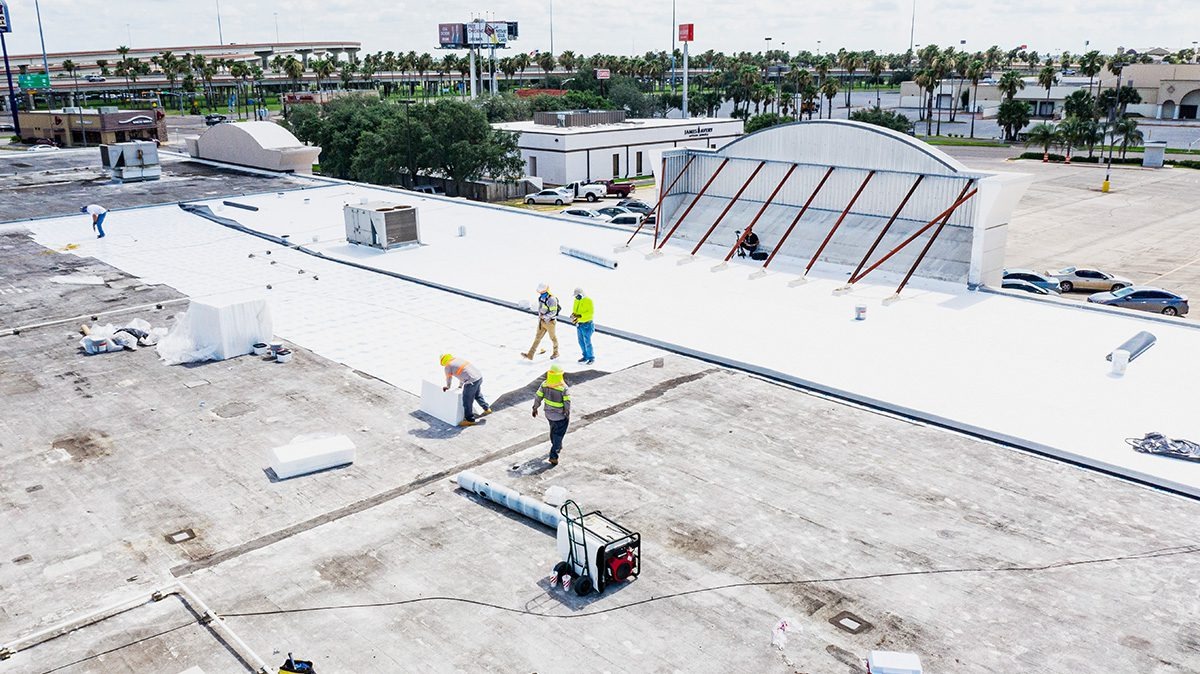
Single-Ply Commercial Roofing in Minneapolis, MN
TPO, EPDM, and PVC are the three single-ply membrane systems that dominate Minneapolis commercial new construction and first-cycle recover work. We specify the right one for the building's use, climate exposure, and capital horizon, not the one with the best manufacturer incentive.
Single-ply roofing systems, membranes manufactured as a single layer of polymer sheet rather than the multi-ply built-up approach, have dominated commercial roofing in the Twin Cities for the past two decades. The economics are straightforward: faster installation than built-up systems, lower material cost than multi-ply, and performance that, when properly specified and installed, is competitive with any system in the market for the Minneapolis climate.
The specification decision between TPO, EPDM, and PVC is where most commercial building owners receive inadequate guidance. Many contractors default to the system they are most familiar with, or the system whose manufacturer is currently offering the best installer incentive program. The right system for a Downtown Minneapolis office tower running 35 psf design snow loads is not necessarily the right system for a food processing facility in Northeast Minneapolis or a corporate campus in Eden Prairie with 100,000 square feet of flat roof and 40+ pieces of rooftop mechanical equipment.
Our single-ply specification process starts with building-specific data: occupancy type, rooftop equipment profile, chemical exposure from exhaust systems, snow load design data, drainage slope analysis, deck type, and the owner's capital horizon. The specification that comes out of that process is defensible, we can explain why we specified the system we specified, and the building's performance over the next 20 to 30 years is the verification.
TPO, thermoplastic polyolefin, is currently the most common single-ply specification for new commercial roofing in the Twin Cities. The reflective white membrane reduces summer cooling load (meaningful on large floor-plate suburban buildings like the Eden Prairie tech corridor and the Bloomington commercial inventory near MoA), heat-welded seam technology produces a seam as strong as the field membrane, and the installed cost is lower than PVC with comparable performance for most commercial applications.
Cold-weather TPO installation requires modified adhesive formulations and heated welding equipment, standard TPO adhesives have minimum application temperatures that are not compatible with November through March installation windows without product substitution. We carry cold-weather TPO adhesives on our trucks for year-round installation and emergency repair capability. A building near the MSP airport industrial corridor or in the Richfield Best Buy corporate area that needs TPO emergency repair in January gets in-system cold-weather material, not a substitute membrane.
TPO seam quality control in the Twin Cities: Heat-welded TPO seams are the highest-quality seam in the single-ply market, but seam quality depends entirely on installation parameters, gun temperature, travel speed, substrate conditions, and ambient temperature. We probe every seam run on every project. Cold-weather welding requires adjusted parameters and more careful quality verification; a seam that was made too fast or at too low a temperature in a January installation will not fail immediately, it will open in the first summer thermal expansion cycle.
Comparing Single-Ply Systems for Minneapolis Buildings
EPDM vs. TPO: EPDM's cold-temperature flexibility advantage over first-generation TPO has narrowed significantly with current TPO formulations, modern TPO remains flexible to -40°F. EPDM still has an advantage in cold-weather installation flexibility (solvent-based EPDM adhesives work at lower temperatures than TPO hot-air welding) and is the better choice for emergency repair in extreme cold. TPO has the cost and reflectivity advantage for new installation.
PVC vs. TPO: PVC is the appropriate specification where chemical resistance (restaurant grease exhaust, industrial solvent exposure) is required. For general commercial application without chemical exposure risk, TPO performs comparably to PVC at lower cost. We specify PVC where the building's use justifies the premium, Uptown restaurant buildings, the Northeast Minneapolis manufacturing corridor, and buildings adjacent to the 3M Maplewood campus with documented chemical exhaust exposure.
Ballasted vs. fully-adhered vs. mechanically-attached: Ballasted single-ply systems (EPDM or TPO loose-laid and held down by river rock) are the lowest-cost installation method but add 10 to 12 psf of dead load, a structural consideration on buildings near the 35 to 40 psf design limit. Fully-adhered systems have the highest wind uplift resistance and are the appropriate specification for Downtown Minneapolis buildings in the wind-channel environment around the IDS Center and Nicollet Mall corridor. Mechanically-attached systems are appropriate for most suburban commercial buildings where wind exposure is standard Category B.
Single-Ply in the Minneapolis Snow Load Environment
Single-ply membranes perform well under snow load because they flex with the structure rather than cracking under the loading cycle. The membrane itself is not the structural concern, the structural concern is the insulation below the membrane and the deck below the insulation. We include a snow load and drainage analysis in every single-ply replacement or recover scope: the new insulation stack must be specified for R-value continuity (Minnesota energy code requires R-30 minimum for low-slope commercial), adequate compressive strength to support design snow loads without crushing, and tapered geometry that directs melt water to drains rather than allowing ponding.
Single-ply drain assembly design for Minnesota: Drains on single-ply systems need to function at the end of ice-dam season, when melt water is flowing while drains may still be partially frozen. We specify drain assemblies with sump configurations that allow flow when the drain body is partially blocked by ice, and we confirm secondary overflow drain installation and function on every project. A single-ply roof that ponds because the primary drains are ice-blocked during the spring melt cycle is a structural risk regardless of how good the membrane is.
Which single-ply system do you recommend for new commercial construction in Minneapolis?
For most new commercial construction in the Twin Cities metro, office, retail, light industrial, TPO is the specification we write most often. It meets energy code reflectivity requirements, produces a high-quality heat-welded seam, and is priced competitively for the value. PVC is the specification for buildings with chemical exposure requirements. EPDM is specified where cold-temperature flexibility and cold-weather installation capability are priorities, or where the building's existing recover history requires an in-kind system.
How does single-ply roofing handle the freeze-thaw cycles in Minneapolis?
Modern single-ply membranes, TPO, EPDM, and PVC in current formulations, are engineered for cold-climate performance. They flex through freeze-thaw cycling rather than cracking. The high-stress points are not the membrane field but the seams, parapet flashings, and drain collar transitions, these are the details that need annual inspection and maintenance to perform through 30 to 50 freeze-thaw cycles per winter. Our maintenance program focuses inspection attention on these details specifically.
Can you replace my existing built-up roof with a single-ply system?
Yes, and in most cases a single-ply system is the right replacement specification for an aging BUR. The replacement scope depends on deck condition (we inspect and document before writing the scope), the need for additional insulation to meet current slope and drainage requirements. Many aging BUR buildings in the North Loop warehouse district and Downtown Minneapolis have insufficient slope for adequate single-ply drainage and need tapered insulation as part of the replacement scope.